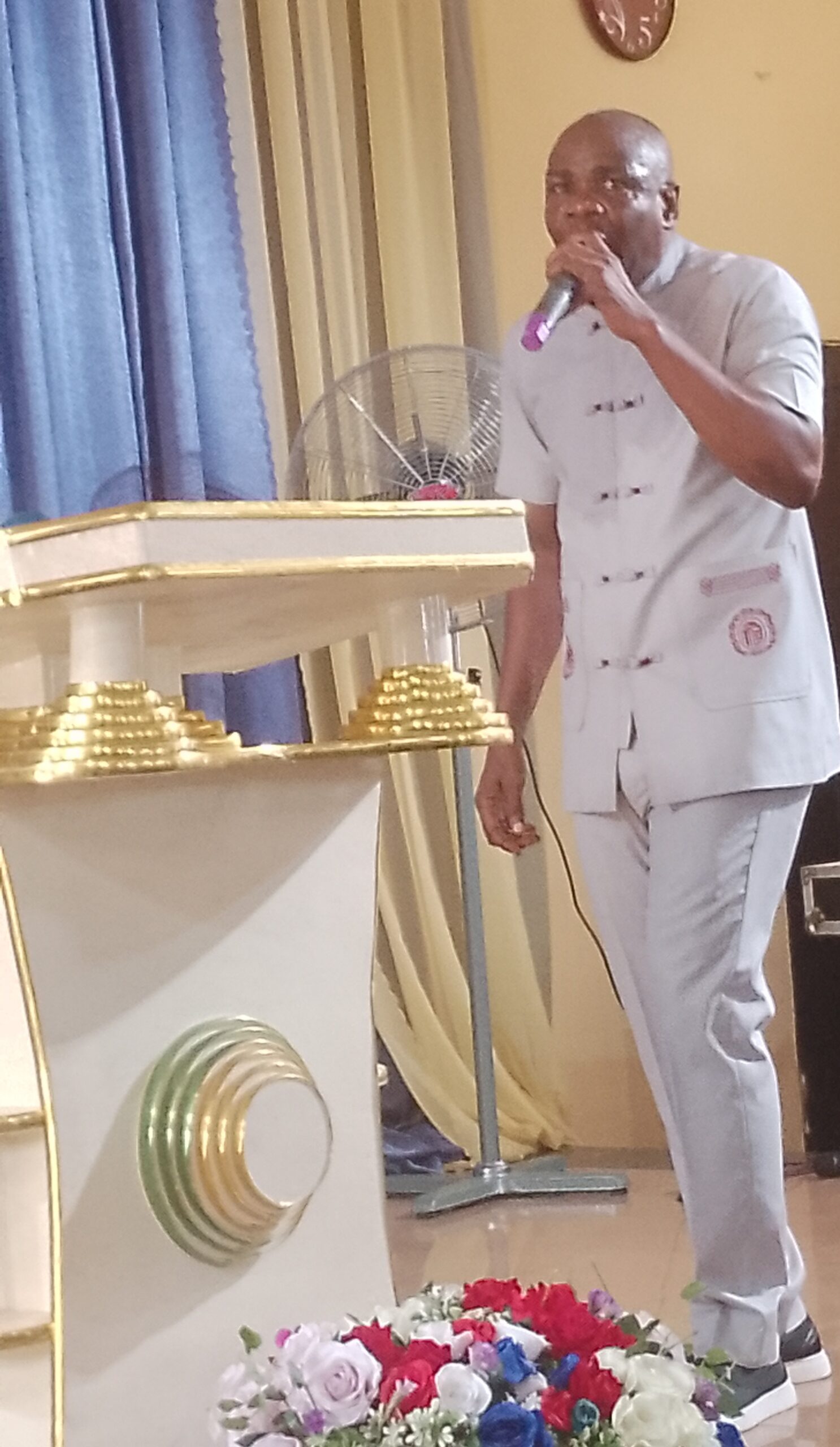

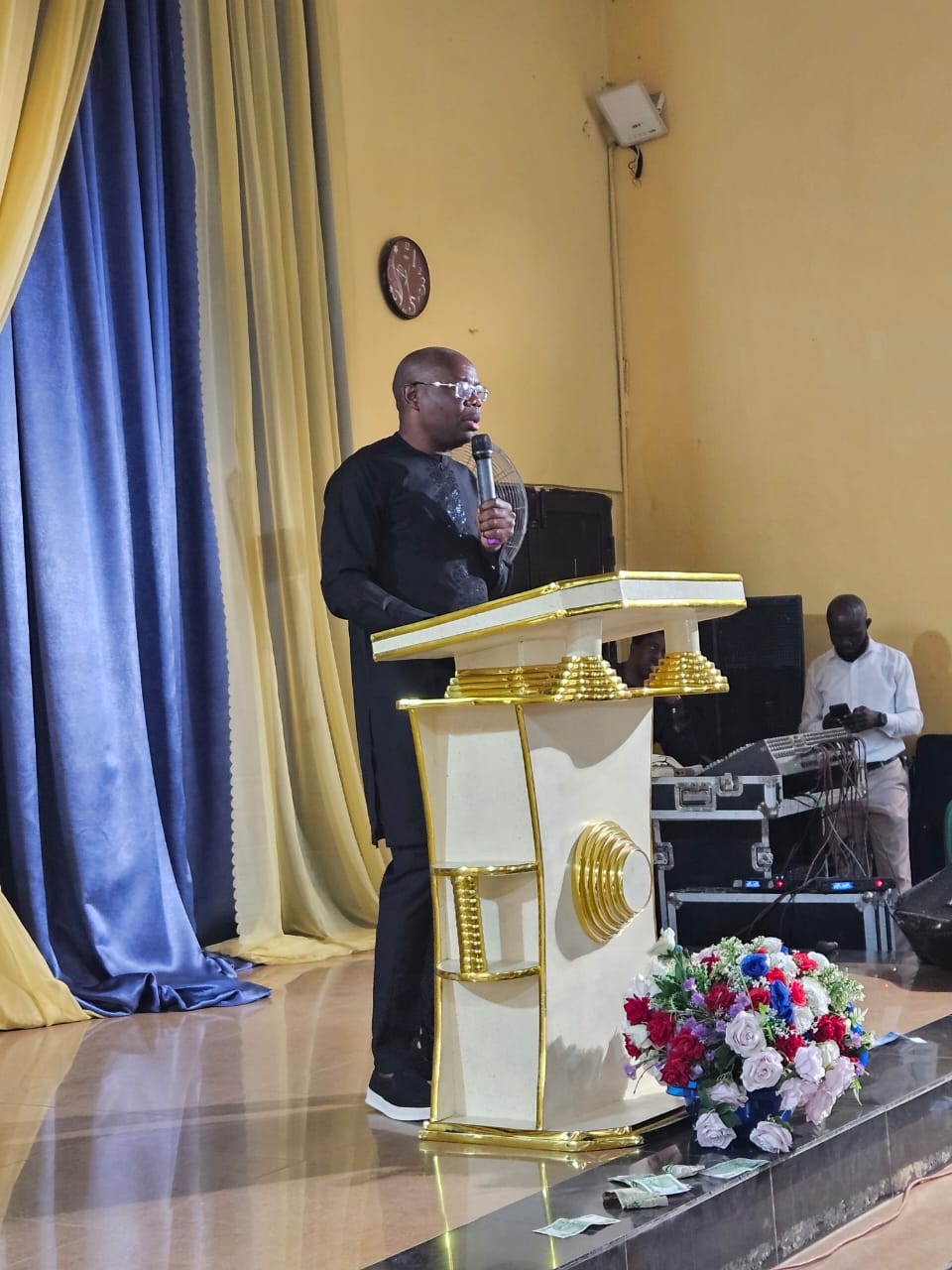
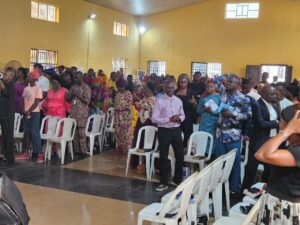
The Sunday worship service at the Acts of Restoration and Compassion Church on August 15, 2026, was a spiritually enriching and thought-provoking gathering centred on the believer’s relationship with God, obedience, preparation and the process through which divine promises are fulfilled.
The service commenced with a powerful worship session led by the choir under the leadership of Minister Prosper, creating an atmosphere of reverence and readiness to receive God’s Word.
Thereafter, the lead pastor, Reverend Paul Chikwem later continued the teaching series, “The God of Abraham,” drawing from Genesis 12:1–5 and Exodus 3:3–13. He challenged the congregation to understand that God does not merely call people to enjoy His promises; He takes them through a process of making, refining and preparation.
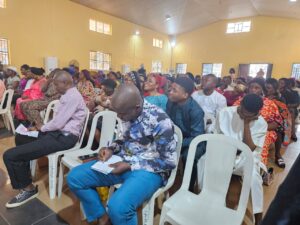
Before beginning the main teaching, Reverend Chikwem stressed the importance of preparing spiritually before coming into God’s presence.
He explained that church attendance should not be reduced to simply filling a congregation. The purpose is to build a people whose hearts are prepared to encounter God.
Believers, he said, should prepare themselves from home and come with hearts ready to receive. If someone comes spiritually unprepared, even a powerful message may have little impact.
One of the central lessons was that God does not always give His children a complete map of their journey. Instead, He gives instructions and expects obedience.
The lesson was clear: God may not reveal everything at once, but obedience to what He has already said opens the way for further revelation.
Returning to Genesis 12, the minister examined Abraham’s call. At 75, Abraham received God’s promise: “I will make you.” However, the making did not happen overnight. Years later, around the age of 99, God spoke to Abraham about what He had made him to become.
This demonstrated that God’s making is a process. The question is not merely whether God has called or chosen someone, but whether that person is willing to submit to the process required to become what God has promised.
Abraham had to move before he could enter the next phase of the promise. Thus, the minister emphasised:
God will move you out before He moves you in.
Reverend Chikwem stressed that God is a God of process. Believers must not become frustrated because the journey is taking longer or becoming more difficult than expected.
He referred to Habakkuk’s teaching about the vision being for an appointed time, reminding the congregation that waiting is not necessarily wasting.
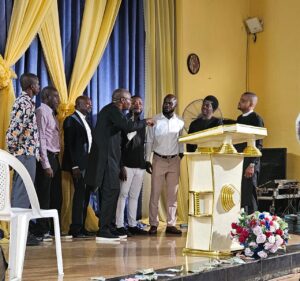
“There is no wasting in waiting when you know what you are waiting for.”
Abraham’s descendants would eventually inherit the promised land, but before that, they would spend generations in another land. The delay was not evidence that God had forgotten His promise. It was part of a larger divine process.
The minister warned strongly against impatience, using Ishmael as an example of what can happen when human effort attempts to produce what God has promised in His own time.
Abraham had received the promise, but Sarah became impatient with the process. The resulting decision produced consequences that extended beyond their immediate circumstances.
The lesson was straightforward: wait when God says wait and move when God says move. Something obtained through impatience may eventually carry repercussions that would have been avoided through obedience and patience.
The Reverend also warned believers to be careful about the voices they permit to influence them.
Using Adam and Eve, he explained that Adam had received God’s instruction, but Satan’s voice eventually influenced the couple to disobey.
The congregation was challenged to examine who advises them, who pushes them and whose voice they listen to. Even strong people can be influenced by the wrong relationships.
When God has clearly spoken, believers must have the courage to stand on His instruction unless He Himself provides another direction.
The minister further advised believers to be careful about what they reveal. Not every revelation, instruction, plan or personal matter should be shared with everyone. Some information can become a source of pressure or confusion when placed in the wrong hands.
The congregation was therefore reminded: Be careful who advises you. Be careful what you receive. Be careful what you share.
Not everyone offering advice has been sent by God, and not every opportunity or relationship is beneficial.
The account of Adam and Eve also raised an important question: What are you receiving from others?
Adam had been receiving from Eve without any problem until she gave him what God had forbidden. The minister encouraged believers not to accept something simply because it comes from someone they love or trust. Before accepting information, opportunities, relationships or influences, they should ask where they came from and whether they align with God’s Word.
Another powerful moment came from God’s question to Adam after the fall: “Who told you that you were naked?”
Reverend Chikwem explained that the question speaks to the kind of knowledge people acquire and the voices through which they acquire it.
Adam and Eve gained knowledge, but that knowledge did not preserve them. Instead, they lost their covering and were driven from the garden.
The lesson was that not every knowledge is beneficial. Believers should wait for God to reveal what they need to know rather than rushing ahead of His timing.
The minister reminded the congregation that difficult seasons should not automatically be interpreted as punishment or abandonment. Sometimes what looks like delay, denial or difficulty is actually God’s protection.
God may be preventing premature exposure, responsibility or consequences. Therefore, believers should not abandon Him simply because the process is uncomfortable.
Joseph’s life provided another powerful illustration.
Before Jacob and his household eventually went to Egypt, Joseph had to go ahead of them. His journey involved betrayal, slavery, false accusation and imprisonment. Yet those painful experiences were connected to God’s larger purpose of preserving a people.
The minister challenged believers not to become so consumed by the unpleasantness of their process that they lose sight of the product God is producing.
Do not allow the unpleasantness of the process to make you abandon the product.
Joseph’s story demonstrates that what appears to be a setback may actually be preparation for a greater assignment.
Reverend Chikwem returned to Exodus 3, where Moses encountered God at the burning bush.
When Moses asked what name he should give the Israelites when they asked who had sent him, God answered: “I AM THAT I AM.”
God then identified Himself as the God of Abraham, Isaac and Jacob.The minister presented these as representing different stages of God’s continuing work, from beginnin, through sustenance and multiplicity.
This demonstrated that God’s work moves through stages and generations.
A recurring pattern emerged from the teaching: God chooses. God separates. God shows. God makes.
The man of God emphasised that making takes time.
Jesus told His disciples that He would make them, demonstrating that divine calling involves transformation rather than instant completion.
People often celebrate products, but God is concerned with the process that produces them. He may reveal the vision while withholding the details of the journey.
The World Cup trophy, for example, is visible as the ultimate prize, but the difficult competition required to win it remains part of the journey. In the same way, God may show a person the destination without revealing every step.
The congregation was encouraged to keep its eyes on what God is producing even when the process becomes painful.
The minister referenced 2 Corinthians 4:16–18, which teaches believers to look beyond temporary afflictions toward eternal realities. Jesus Himself endured suffering because of the joy set before Him.
Therefore, the vision of what God is producing can provide strength to endure the process. The process may be painful, but the product can bring joy.
Another important lesson was that visible silence does not mean divine absence. Sometimes God appears inactive while He is working beneath the surface. A product that has not passed through the appropriate process may not be strong enough to endure.
God therefore uses process to strengthen, refine and prepare what He intends to establish.
When God says, “I will make you,” the process itself becomes evidence that the Maker is still at work.
The sermon concluded with a practical challenge: believers must move beyond passive faith.
The minister declared that the Word works when you work.
It is not enough to hear God’s promise, pray about it and remain inactive. Believers must act in accordance with what God has spoken.
In simple terms: Do not only pray and watch. Pray and work.
The Word must be activated through obedience and action. What God has spoken requires the believer’s participation.
The Sunday service delivered a powerful reminder that God’s promises are often fulfilled through a process of obedience, waiting, preparation and transformation.
Through Abraham, Isaac, Jacob, Moses, Adam, Eve and Joseph, the congregation was challenged to understand that divine fulfilment is not always immediate. God chooses, separates, shows and makes.
The process may be long, painful or uncomfortable, but it is often the very instrument God uses to prepare His people for what He has promised.
Believers were encouraged to guard their hearts, listen carefully to God’s voice, choose their influences wisely, protect divine instructions, resist impatience and remain faithful even when the journey becomes difficult.
Above all, the service left the congregation with a practical charge:
If God has spoken, obey. If He says wait, wait. If He says move, move. And when He gives you a Word, do not merely pray about it, work on it.
The God of Abraham is still the God of process, the God who begins, sustains and ultimately completes what He has ordained.