
By Amah
Kindly share:
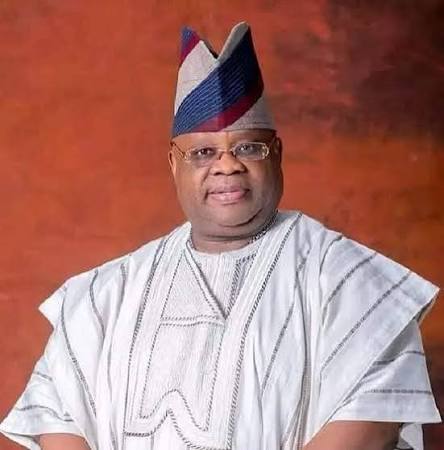
Adeleke defeats APC’s Oyebamiji as INEC declares Accord candidate winner of 2026 Osun governorship election
Governor Ademola Adeleke has secured a second term in office after the Independent National Electoral Commission (INEC) declared him the winner of the 2026 Osun State governorship election.
Adeleke, who contested on the platform of the Accord Party, defeated his closest challenger, Bola Oyebamiji of the All Progressives Congress (APC), in a closely watched contest that pitted the incumbent governor against a major opposition challenge.
According to the final results announced by INEC, Adeleke polled 511,067 votes, while Oyebamiji secured 444,815 votes, giving the incumbent a winning margin of 66,252 votes.
The result means Adeleke will continue as governor of Osun State for another four-year term.
Adeleke Wins 19 LGAs, Oyebamiji Takes 11
The governor prevailed across 19 of Osun State’s 30 local government areas, while Oyebamiji won 11 LGAs.
The Accord candidate’s performance was particularly significant because the election was regarded as a major test of the incumbent’s popularity and the APC’s ability to reclaim the state.
The African Democratic Congress (ADC) candidate, Najeem Salaam, finished a distant third.
INEC’s declaration followed the completion of the collation of results from the state’s 30 local government areas. Reports during the collation had already placed Adeleke in a commanding position, with results uploaded to the commission’s Result Viewing Portal showing the incumbent ahead of his major challenger.
A Rematch With Political Significance
The 2026 Osun governorship election carried considerable political weight because it represented another major contest between the forces associated with the ruling APC and Adeleke’s political camp.
Adeleke first became governor in 2022, when he defeated the then-incumbent APC governor, Gboyega Oyetola. In that election, Adeleke polled 403,371 votes against Oyetola’s 375,027, winning by about 28,000 votes.
Four years later, the political equation changed considerably. Adeleke contested under the Accord banner and again emerged victorious, this time increasing his winning margin to more than 66,000 votes.
The latest result therefore gives the governor a stronger numerical mandate than he secured in 2022.
The election was contested by multiple political parties, but the race quickly developed into a two-horse contest between Adeleke and Oyebamiji.
As results began to emerge, Adeleke established an early advantage. By the time results from virtually all the state’s wards had been uploaded, the incumbent was maintaining a substantial lead.
The contest also produced several notable local-government battles.
In Osogbo, the state capital, Adeleke secured 36,480 votes against Oyebamiji’s 30,474. In Iwo, Adeleke polled 27,085 votes to Oyebamiji’s 19,660.
Adeleke also recorded sizeable victories in areas including Ede North, Ede South, Egbedore, Ila, Ife East and Ife South, while the APC candidate maintained strongholds in several other parts of the state.
The overall pattern showed a geographically competitive election, but Adeleke accumulated enough victories across the 30 LGAs to secure the statewide majority.
One of the most important features of the 2026 result is the size of Adeleke’s winning margin.
In 2022, the governor won with 403,371 votes against Oyetola’s 375,027 — a difference of 28,344 votes.
In 2026, Adeleke’s 511,067 votes against Oyebamiji’s 444,815 produced a margin of 66,252 votes.
That represents a significantly wider gap between the leading candidates and suggests that the incumbent was able to consolidate enough support to withstand the APC’s challenge.
The Osun election was closely followed because of its implications for the political landscape ahead of Nigeria’s 2027 general elections.
The contest provided another indication of how incumbency, party organisation, local political structures and voter sentiment can combine to determine outcomes in Nigeria’s off-cycle governorship elections.
There were also reports of isolated incidents of violence, intimidation and alleged vote buying during the election. Punch reported incidents involving disruption at some polling and collation locations, while other reports highlighted allegations of vote buying.
Despite those concerns, the election proceeded to final collation, with INEC ultimately declaring Adeleke the winner.
The victory gives Adeleke another four years to implement his administration’s programmes and consolidate his political influence in Osun State.
It also represents a setback for the APC’s attempt to regain control of the state after losing the governorship to Adeleke in 2022.
For Oyebamiji and the APC, the result will likely trigger further examination of the party’s campaign strategy, grassroots organisation and performance across the 30 local government areas.
For the Accord Party, Adeleke’s victory is an important demonstration that the incumbent could retain power despite contesting under a different party platform from the one on which he originally won the governorship.
The 2026 Osun governorship election has therefore delivered a clear political verdict: Ademola Adeleke remains governor of Osun State, securing a second term with 511,067 votes and a 66,252-vote margin over APC’s Bola Oyebamiji.
The result also sets the stage for the next phase of Osun politics, as attention gradually shifts toward the 2027 general elections and the broader political consequences of the governor’s renewed mandate.