

By Anthony Iwuoma
Kindly share:
Nigeria has many national pastimes: queueing for fuel, blaming colonialism for post-independence sins, and discovering moral outrage only when someone threatens an established racket.
To this list we can now add a new sport; self-interest shaming, deployed with impressive energy against Aliko Dangote, the owner of Dangote Refinery, in the ongoing tango between his refinery and Farouk Ahmed’s regulatory baton.
The Dangote–Farouk tango captures the clash between private industrial ambition and public regulatory inertia in Nigeria’s oil sector. As Dangote pushes to refine locally and break fuel import dependence, Farouk Ahmed, CEO, Nigerian Midstream and Downstream Petroleum Regulatory Authority,
NMDPRA, representing the regulatory establishment, embodies a system accused of foot-dragging, mixed signals, and quiet resistance to reform. The tango is less personal drama than a metaphor for a country dancing awkwardly between progress and entrenched interests.
Dangote accuses Farouk Ahmed, of deliberately undermining local refining, especially the Dangote Refinery, by issuing import licences and regulatory decisions that favour fuel importers over domestic producers. He also alleges regulatory obstruction, economic sabotage, and possible corruption, arguing that Farouk’s actions keep Nigeria trapped in fuel import dependence and protect entrenched interests rather than the national economy. He further suspects that this could not be for nothing and therefore demands an inquiry into how a public servant like Farouk is able to spend millions of dollars finance the school fees of his children in Switzerland.
However, an allegation, delivered with a straight face by critics is that Dangote is fighting for himself. One almost expects violins. In a capitalist economy, no, even in Nigeria’s peculiar hybrid of capitalism, cronyism, and ceremonial outrage, self-interest is not a crime. It is the engine. What is fascinating is not that Dangote has interests, but that Nigeria suddenly pretends to be offended by them.
For decades, Nigeria’s oil sector has been a carnival of naked self-interest.
Importers have made fortunes without importing efficiency. Regulators have regulated motionlessly. Middlemen have lived large on paper transactions involving fuel that sometimes never arrived, or arrived smelling suspiciously like diluted disappointment. Through it all, the nation was told to be patient, to understand that refining locally was “complicated,” “unviable,” or “unsafe.”
That was what the MTNs of this world told us during the birth of GSM, that per minute billing was impossible until home brewed Mike Adenuga and his Globacom demystified everything. We swallowed those explanations like bitter medicine, even as countries with less oil and less drama refined successfully.
Then one man decided to be selfish enough to test the lie.
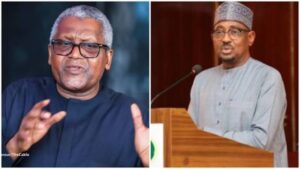
Thus began the Dangote–Farouk tango: a curious dance where progress leads and bureaucracy resists, where a refinery built with audacity meets a regulator armed with caution, some of it legitimate, much of it oddly selective.
Nigerians watched, popcorn in hand, as the argument unfolded not merely as a technical disagreement, but as a symbolic battle over who controls the future of the oil sector.
The first thing this tango exposed is Nigeria’s warped moral compass. We are not angry that the nation imported fuel for decades despite sitting on crude oil. We are not angry that refineries became metaphors rather than machines. We are angry that someone might make money fixing the problem.
Let us, for the sake of intellectual honesty, grant the accusation in full: Dangote is fighting for self-interest. So what?
Self-interest is what made him sink billions into cement when Nigeria was importing bags of dust at extortionate prices. Self-interest is what built sugar, salt, flour, and now a refinery, projects that require patience, capital, and a willingness to wrestle Nigerian infrastructure demons. This is not the self-interest of a man looking for quick profit; it is the self-interest of a man betting against Nigeria’s reputation for frustrating those who dare to build.
If Dangote wanted easy money, he would have joined the import club. He would have perfected the art of invoicing, subsidy whispering, and regulatory handshakes. He would not have built a refinery that stands like an unwanted mirror before an industry allergic to reflection.
That mirror is the real problem.
The Farouk–Dangote tango has revealed the rot in the petroleum ecosystem more effectively than any probe, white paper, or Senate hearing. When a local refinery finally emerges, the instinctive reaction should be to ask: how do we make this work safely, efficiently, and competitively? Instead, the dominant mood has been suspicion; why is he doing this? Who does he think he is? What is his angle?
Nigeria has reached the stage where doing the right thing automatically triggers conspiracy theories.
This is where the regulator enters the dance floor. Farouk Ahmed represents an institution that should inspire confidence. Regulation, after all, is not an enemy of progress; it is its guardian. Standards matter. Quality matters. Safety matters. But regulation becomes farce when it appears selective, when imported fuel of questionable quality passes inspection with the ease of a VIP at an airport, while locally refined fuel faces a gauntlet of newly rediscovered rules.
Nigerians are not opposed to regulation; they are opposed to regulation that looks like protectionism for incompetence.
This is why Farouk’s resignation is not enough; the matter must not end there. More heads must roll, not out of spite, but out of necessity. The existence of the Dangote Refinery has exposed how many careers, contracts, and conveniences were built on Nigeria’s failure to refine. Someone benefited from scarcity. Someone benefited from delays. Someone benefited from the myth that we could not do what other nations do routinely.
Those beneficiaries are now uncomfortable, and discomfort often disguises itself as patriotism.
The accusation of monopoly is particularly rich. For years, Nigeria operated a de facto import monopoly, where a handful of players dominated fuel supply under the watchful eyes of regulators who saw nothing wrong.
Suddenly, when a local refinery threatens to alter that arrangement, monopoly becomes a moral emergency. One wonders where this moral energy was when Nigerians paid through the nose for fuel refined thousands of miles away. One wonders why those who got licences to build refineries have not done so. One wonders why in spite of all the billions of naira dunk into the turn around maintenance of the county’s four refineries never worked and nobody ever told us why or made to pay for that humongous wastages.
Dangote is not asking for monopoly; he is asking for fairness. He is asking that local production not be punished for existing. He is asking that the rules apply evenly, not generously to imports and harshly to domestic capacity.
Nigeria claims to want industrialisation but panicks when industry actually shows up. We say we want foreign exchange stability but defend systems that drain dollars daily. We lament unemployment but interrogate those who create jobs. We complain about infrastructure decay but harass those who build infrastructure.
In this upside-down republic, self-interest becomes suspicious only when it aligns with national interest.
Methinks Dangote asked a mere question, which an honest probe could answer. How is Farouk able to fund his children’s education in Switzerland? It’s as simple as that. The claim could be false, but if true, maybe Farouk inherited a fortune; Nigerians should know. He is just the starting point for all public servants living large, far above their income. Nigeria must begin to hold its personnel accountable.
The Farouk–Dangote tango is, therefore, not personal. It is philosophical. It asks a dangerous question: what if Nigeria worked? What if refining locally became normal? What if regulators regulated without fear or favour? What if the oil sector stopped being a feeding bottle for the connected and became a productive engine for the country?
These questions terrify those who thrive in chaos.
More heads must roll because this moment demands accountability beyond press statements. There must be a serious audit of how fuel quality has been assessed over the years. There must be transparency about who benefits from imports and why local refining was discouraged for so long. There must be in-depth inquiry into failed multi-million naira TAM projects.There must be consequences for those who turned regulation into obstruction.
Rolling heads is not about vendetta; it is about deterrence. It is about signalling that Nigeria can no longer afford institutions that sabotage progress under the guise of procedure. This should extend to trade unions in the oil sector who are hands in glove with the menace in the industry.
Defending Dangote, if you call it that, does not mean canonising him. He is not a saint; he is an industrialist, and a capitalist. He will make money. He should make profit from his daredevilry investments. But he is also doing something the Nigerian state failed to do for decades. That contradiction should humble us, not anger us.
The real scandal is not Dangote’s self-interest; we all have delf-interest. The real scandal is how many people’s self-interest depends on Nigeria never standing on its feet.
As the tango continues, Nigerians must decide what kind of music they prefer. The old tune; import, scarcity, subsidy, blame, has played long enough. It is familiar, yes, but it leads nowhere. The new rhythm; local refining, competition, regulation with integrity, feels unfamiliar, even uncomfortable. But it leads forward.
So, yes, let us agree loudly: Dangote is fighting for himself. But in a country where too many have fought only against Nigeria, his brand of self-interest looks dangerously like progress.
And that, more than anything, is why the dance has become so tense.