
By Anthony
Kindly share:
By Anthony
Kindly share:
The political temperature in Okigwe Zone appears to be changing, as Attorney Charles Chibuike Onyirimba’s expanding grassroots support base continues to draw people across party lines.
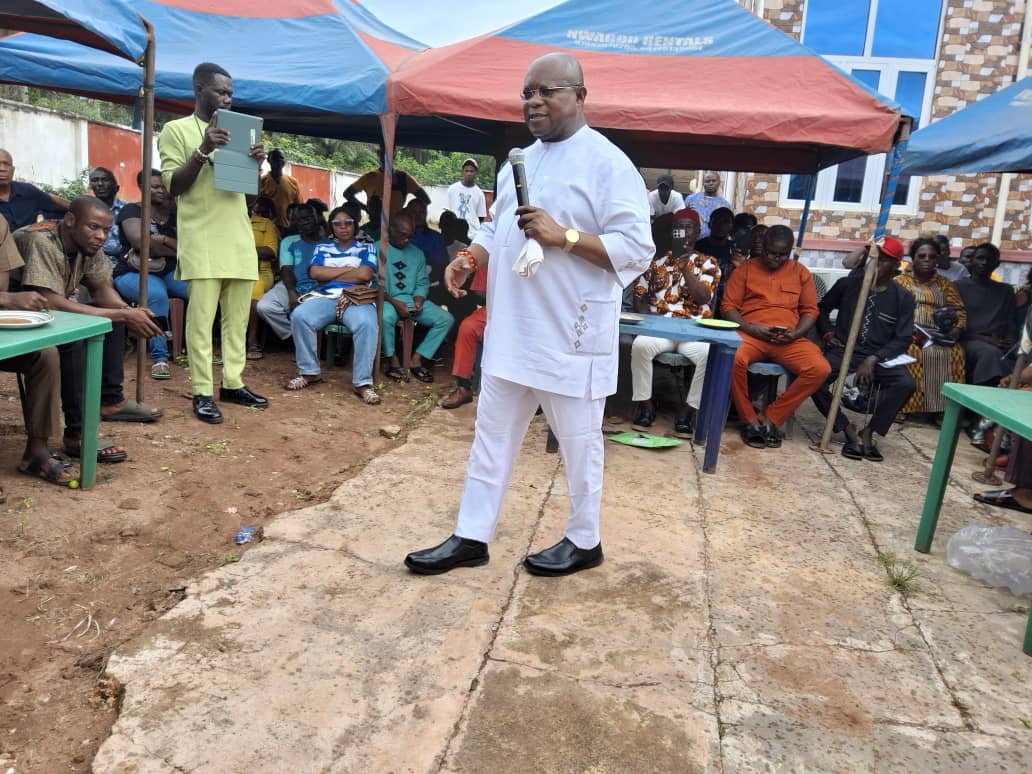
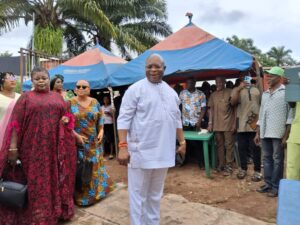
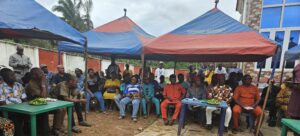
The latest expression of support came during a visit to Ndi Ezi Enyi, a community-based group. According to its chairman, Chief Akarugo Amadi, the group deliberately distinguishes itself from a political party. Its membership cuts across different political parties, but its members were united by what they described as a shared desire for better representation and a new direction for Okigwe Zone.
Each clan within the group reportedly brought 10 representatives to the gathering, creating a broad platform for interaction with the Onyirimba campaign team.
Introducing the delegation, the Chief Strategic Officer of the campaign, Chief Ferdinand Ogor, explained the purpose of the visit and urged members of the group to support Onyirimba’s senatorial aspiration. He stressed that the campaign was about taking a message of hope and a new development agenda directly to the people.
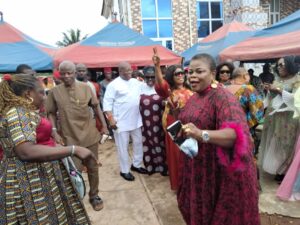
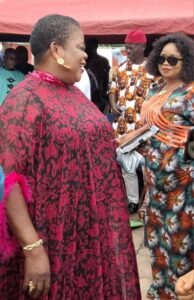
Director-General of the campaign, Mrs. Favour Nwelue, brought the gathering to its feet with a passionate declaration that the Senate seat is not the personal property of any candidate.
“The Senate is not Onyirimba; it is Okigwe,” she declared, stressing that the ultimate question should be who can represent the interests of the entire zone when difficult matters arise.
According to her, when Okigwe needs someone to stand up and fight for its interests, “look for who will go, and who has the capacity.”
She urged the people to look around their communities and honestly assess whether the present condition represents what they desire. She argued that Okigwe must be redefined through active participation, insisting that political change cannot happen without citizens using their Permanent Voter Cards.
She called on the people to come out en masse, vote, insist that their votes count and refuse to be intimidated.
Nwelue also warned against vote-buying, describing it as one of the factors contributing to the zone’s political and developmental difficulties.
“Do not sell your conscience,” she urged. “Do not eat pittance now and suffer for four years.”
She described Onyirimba as an Okigwe son with the legal knowledge, experience and courage required to make a difference, declaring that the time had come for the zone to demonstrate that it had people capable of representing it effectively.
“Okigwe has been messed up, but Okigwe has a son who can make a difference,” she said.
For the ADP senatorial candidate, the encounter was not simply another political gathering. It was an opportunity to challenge what he described as a dangerous culture of resignation.
“We have come to spread a message of hope,” he told the gathering.
He acknowledged the hardship confronting Nigerians and the sense of helplessness that has caused many people to accept poor conditions as inevitable. But, he argued, resignation to fate should not become the permanent condition of a people.
Instead of saying, “that is the way it is,” he urged the people to begin saying, “it can be better.”
Onyirimba explained that the Senate is the highest legislative chamber of the country and that lawmakers have a responsibility to ensure that the interests of their constituents are reflected in national legislation, appropriations and government programmes.
He challenged the people to ask questions whenever the benefits due to their communities are not forthcoming.
“What does a senator do?” he asked rhetorically, before explaining that beyond lawmaking, senators participate in the appropriation process and can advocate for projects, programmes and allocations that address the needs of their constituents.
For him, representation must therefore go beyond occupying a seat in Abuja.

He lamented that despite the educational and professional strength of Okigwe Zone, the area has continued to struggle with development challenges.
“We are educated and enlightened. But with all that knowledge, what have we done with it?” he asked. “Orlu and Owerri have developed, and we cannot continue to lag behind in a state where we have the largest number of educated people. Never again!”
He said the time had come for Okigwe Zone to “showcase our first eleven,” using the language of football to argue that the zone must identify and support people with the competence, experience, character and capacity to serve.
“So far, we have been represented by individuals of interest, not individuals who constitute the first eleven of Okigwe Zone,” he said. “Now, the destiny of Okigwe Zone must be put in our hands. We must handle our destiny by ourselves.”
“We are now saying: enough is enough,” he declared, insisting that the people must assert their right to choose their representatives rather than have political choices imposed upon them or be looked down upon.
“I have come so that Okigwe Zone would not be shortchanged again,” he said. “I want you to be proud to see your senator talking on television and representing you with confidence, knowledge and dignity.”
Onyirimba said effective public representation required more than academic intelligence.
“You must have the two elements of being smart, in the classroom and in the street, in this competitive world,” he said, adding that being smart alone was not enough to survive.
“There are many professionals who are smart, but…” he said, stressing the need for professional knowledge to be matched with practical understanding, empathy and service.
He drew from his legal training to make the point.
“I am trained in the art of law writing, law interpretation and law application,” he said. “You can be a good lawyer in the courtroom but not be a good public servant. You can be a good lawyer and earn money, but all the money you are making may be for yourself and your family.”
For him, knowledge of the law must be accompanied by empathy.
“When you know the law, when you apply the law, you must add empathy to it,” he said. “As a legislator, you must know how to write laws, interpret them and apply them, but you must also have empathy and relate to the people and the society around the zone.”
He argued that a representative must know what is happening in each community to represent the people effectively.
“You must know what is happening in each community to be able to represent them effectively. You do that through regular constituency interface, including town hall meetings. Sadly, that has not been the case in Okigwe.”
Onyirimba therefore called for what he described as a reinvention of government.
“Let us reinvent government. Let us use the knowledge we have. Try Charles Onyirimba and see what the result will be.”
The candidate said his aspiration was not driven by a desire for political status or access to Abuja privileges. Rather, he described himself as someone seeking to become a “chief servant” of Okigwe Zone, with the responsibility of fighting for what belongs to the people and ensuring that their interests are protected and preserved.
“I am a seasoned lawyer in America, with all the comforts of life. I have willingly sacrificed all that to serve my people,” he said. “I have come home not to make a name or simply to be called a senator, but to be the chief servant of Okigwe Zone, to ensure that whatever Okigwe is entitled to is gotten for them, protected for them and preserved for them.”
He said he was not seeking the office for financial gain.
“I didn’t come for your money. There is no amount of money that can equate the comfort that I already have and enjoy in America,” he said. “I have left all that to enter the jungle called home, to make life more meaningful for my people.”
He invoked the familiar saying, “East or West, home is the best,” arguing that Nigerians in the Diaspora should not merely enjoy the comfort of foreign countries and return home only for burial.
“We cannot make Nigeria a burial ground for overseas people,” he said. “They stay there and enjoy all the comfort only to die and be brought home for burial. Nigeria is not a burial ground. That is why we must make it better.”
According to him, the responsibility of the people is to transform their communities and make them productive and economically viable.
“It is our duty to convert our land into a productive and economically viable entity that Peter Obi talks about all the time,” he said. “I am here to sacrifice my time and energy for your own good.”
Onyirimba also drew a distinction between his motivation for seeking office and what he described as the economic considerations that drive some political aspirants.
“Many of those running for office are looking for an economic lifeline. I’m not looking for viability,” he said.
He noted that he has eight brothers, all living in America, and said even people at home had questioned his decision to embark on the political journey.
“Call your brothers in America and just mention my name. They will tell you that my life is a life of service,” he said.
He proceeded to recount a long list of his activities and leadership roles in the United States and within Nigerian and Igbo communities in the Diaspora.
“I founded and appointed the first Mbano, Imo State National Assembly in the USA,” he said. “I was a former president of the Igbo community in Georgia. I was a former president of Imo State Congress of America. I was a former president of the Nigerian-American Bar Association.”
He added: “If I can speak for Nigerian lawyers in America, I believe I can speak for Okigwe Zone.”
Onyirimba also recalled his voluntary service as Honorary Consul-General for Nigeria in Atlanta for three years.
“If I could do that for Nigeria, I can do much more for Okigwe Zone,” he said.
He further recalled his role as chairman of the Nigeria Olympic Committee in 1996, saying his involvement contributed to Nigeria securing gold.
“If I could serve as the chairman of the Nigeria Olympic Committee in 1996, where I helped Nigeria secure gold, I can do it for Okigwe Zone,” he said.
Turning to Nigeria’s return to democratic rule in 1999, Onyirimba said he brought a team from the United States and organised training for elected officials on the processes and procedures of democratic governance.
“When Nigeria returned to democracy in 1999, all the people elected then, I brought a team from the United States and organised training for them on the processes and procedures of a democratic process,” he said.
He disclosed that elected officers in Imo State, from the House of Assembly to the House of Representatives and Senate, attended the lectures on the rudiments of democracy, except Arthur Nzeribe.
“If I could do this, I would do similarly for Okigwe Zone,” he said.
Onyirimba also recalled his relationships with prominent Nigerian statesmen, saying he could call General Yakubu Gowon and have him respond to his call in Atlanta and come to speak to the people.
“I could call Dim Emeka Odumegwu-Ojukwu, and he would answer my call in Atlanta and come to speak to our people,” he said.
“I could call Chief Sam Mbakwe, and he would answer my call in Atlanta and come to speak to our people.”
He also recalled his role as moderator during the two presidential election campaigns of Chief Olusegun Obasanjo whenever Obasanjo visited.
“These are verifiable,” Onyirimba said.
He maintained that these experiences were acquired when he had no political interest in Okigwe Zone and argued that they demonstrated a longstanding commitment to leadership, community organisation, diplomacy, law and public service.
“If I did all these when I had no political interest, you can imagine what I could do when I represent the good people of Okigwe Zone,” he said.
He also recalled his previous political contests, saying he had won elections twice but was denied victory through political manoeuvring. According to him, however, he chose not to respond with bitterness.
He said one of the beneficiaries of his stolen victory later confessed and prayed for him, saying that his own time would come and that nobody would be able to stop it.
Onyirimba told the gathering that he believes that time has now arrived.
“Try Charles Onyirimba and see the difference,” he said.
He promised that, if elected, his priorities would include economic clusters for young people, microeconomic projects capable of transforming livelihoods and programmes designed to restore confidence among the youths.
“I want to be their destiny helper,” he declared.
He also argued that after parents have spent years educating and supporting their children, the next generation should become capable of taking care of those who raised them.
His message was anchored on the belief that professional knowledge must ultimately be translated into practical service.
“A lawyer must not only know the law,” he said. “In substance, he must understand the people, empathise with them and use his knowledge to solve their problems.”
Onyirimba therefore called for constant interaction between representatives and constituents, questioning whether elected representatives had sufficiently engaged ordinary people through town-hall meetings and direct consultations.
“Let us reinvent government,” he urged. “Let us use our knowledge for the good of the people.”
The gathering also featured inspirational songs, adding an emotional and communal dimension to the encounter.
The message from the Onyirimba camp was clear: political participation must ultimately be about the people and their future, rather than party labels alone.
And that message appeared to resonate beyond the gathering.
Later that evening, another group, also cutting across political party lines and several wards in the zone, arrived at his house to declare its support for Onyirimba’s senatorial aspiration.
The development has added another layer to a campaign that has been described as a growing grassroots movement.
From one community to another, from party members to people who say they are motivated primarily by the future of Okigwe Zone, Onyirimba’s campaign is increasingly presenting its support base as a coalition that transcends conventional party boundaries.
But one thing is becoming increasingly visible: the political conversation around Okigwe Zone is widening, and Attorney Charles Onyirimba is placing himself firmly at the centre of that conversation.
With each engagement, the campaign argues, the coast is becoming clearer and the call for a new development conversation in Okigwe is becoming louder.
The final decision, however, remains with the people of Okigwe Zone, whose votes will ultimately determine who represents them in the Senate. However, Onyirimba believes he has an edge because the people of Okigwe have always been his backbone and godfathers, as espoused in his Okigwe Peoples Party philosophy. The ADP candidate says he remains unshaken that he has an edge as Okigwe people have always been his backbone and godfathers, which he declared in his Okigwe Peoples Party philosophy.