


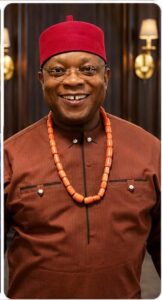
Onyirimba
By Anthony Iwuoma
Kindly share:
As the political season leading to the 2027 general elections begins to take shape, something appears to be changing in the political atmosphere of Okigwe Zone.
The familiar names remain. The established parties remain. Long-standing alliances, networks and political loyalties remain part of the equation. Yet beneath that familiar political landscape, a new conversation is emerging; one increasingly centred on choice, representation, accountability and what the people should reasonably expect from those seeking their mandate.
At the centre of this emerging conversation is the decision of Attorney Charles Onyirimba to contest the 2027 senatorial election on the platform of the Action Democratic Party (ADP). It introduces another variable into a political equation traditionally influenced by party structures, established personalities, alliances and historical loyalties.
For many years, political contests have often been framed around personalities and party affiliations. Candidates seek the backing of influential individuals, political structures mobilise supporters, and voters make choices based on a combination of loyalty, performance, relationships, expectations and local interests.
Voters may begin asking more fundamental questions: What has representation delivered? What should a senator actually do for the people? What qualities should determine the choice of a representative? And how should elected officials be held accountable after receiving a mandate?
These questions give the emerging ADP–Onyirimba candidacy a broader political context.
Onyirimba’s supporters point to his professional background, international exposure, philanthropic activities and interest in public service. Those attributes, however, must ultimately be translated into a convincing proposition for the electorate.
The commencement of the 2027 campaign should therefore move the conversation beyond the question of who will occupy the Senate seat. A more useful question is: What kind of representation does Okigwe Zone require?
A senator’s responsibility extends beyond physical presence at legislative sessions.
There is also the question of development.
How can federal opportunities be attracted to the zone? How can constituency concerns receive greater attention? How can communities maintain meaningful contact with their representative? What policy issues affecting agriculture, education, infrastructure, employment, healthcare, small businesses and youth development deserve legislative attention?
These are issues on which every candidate entering the 2027 race should be prepared to speak clearly.
The electorate should have the opportunity to compare competing answers rather than merely competing personalities.
For ADP, the challenge is equally significant.
Its emergence in Okigwe Zone presents an opportunity to articulate a political proposition that goes beyond the familiar language of party competition. The critical questions are straightforward: What does ADP stand for in real terms? What would its candidate seek to accomplish differently? How would constituency representation be approached? How would relationships be built across the six LGAs? And how would campaign promises be converted into measurable commitments?
The answers begin with a simple principle: political office should be treated as a public trust, not a personal entitlement.
In practical terms, the ADP proposition can be distinguished by competence, accountability, inclusive representation and development-focused politics. For Okigwe Zone, that means promoting a style of representation in which the senator remains connected to constituents, understands their concerns, pursues legitimate interests at the National Assembly and regularly accounts for the responsibilities entrusted to the office.
The central proposition is straightforward: winning an election is not the achievement; it is the beginning of the responsibility.
Attorney Charles Onyirimba offers an opportunity to make measurable performance and accountability central to his political proposition. The difference is not simply in what he promises, but in the method by which he intends to pursue those promises.
Onyirimba’s approach can be summarised as: listen, prioritise, legislate, advocate, pursue implementation and report back. That creates a basis upon which constituents can evaluate the performance of their representative beyond campaign rhetoric.
His representation would not disappear after the votes have been counted, as has been the case. The proposed approach would establish a continuous constituency engagement system, covering the six local government areas of Okigwe Zone.
Such a system would provide regular opportunities for consultation with communities and stakeholder groups, enable constituents to communicate their concerns and create mechanisms for following up on issues requiring federal intervention.
The constituency office should become more than an administrative address. It should serve as a channel through which constituents can raise concerns, seek information, present development priorities and follow the progress of legitimate interventions. The underlying principle is that representation should be accessible, responsive and accountable.
Onyirimba proposes a credible senatorial project broad enough to accommodate the diversity of the component six local government areas of Okigwe Zone: Onuimo, Okigwe, Isiala Mbano, Ehime Mbano, Ihitte/Uboma and Obowo, a position strengthened by the provision of office space for every local government inside the campaign office at Umunakanu, Ehime Mbano. The approach is based on equity, consultation and inclusion, rather than concentrating attention on a handful of communities or political strongholds.
Perhaps, one of the most potentially transformative dimensions of the Onyirimba proposition is the opportunity to connect Okigwe Zone more deliberately to the enormous resources, expertise, networks and investment opportunities available within the Nigerian Diaspora and the wider international community.
Onyirimba’s international exposure, professional relationships and networks beyond Nigeria could provide a platform for creating credible channels through which Diaspora professionals, entrepreneurs, investors, development organisations and philanthropic institutions can identify viable opportunities across the six LGAs.
The possibilities extend well beyond direct financial investment. They include technology partnerships, healthcare initiatives, education and skills-development programmes, agricultural ventures, renewable energy, entrepreneurship, professional exchange, infrastructure support and other forms of knowledge and capital transfer.
The objective is to use his influence, networks and convening capacity to open doors, connect credible investors with viable local projects, facilitate strategic relationships and position Okigwe Zone more prominently on the international development and investment map.
Properly structured, a Diaspora engagement strategy could help transform Okigwe people abroad from occasional donors and observers into long-term partners in the zone’s economic and social development.
This could be particularly significant because Okigwe Zone possesses human capital far beyond its geographical boundaries. The challenge is how to organise that human capital into a development network capable of generating sustainable value at home.
The responsibility of a senator is not to personally execute every federal project. It is to use the powers and influence of the office to legislate, advocate, facilitate, oversee and pursue legitimate development interests on behalf of constituents. Where an objective requires collaboration with federal ministries, agencies, the state government, development partners or private investors, trust Onyirimba to acknowledge it honestly.
Ultimately, the strongest case ADP and Onyirimba is making is not simply that they represent a new political option. It is that they are prepared to establish a different standard by which representation can be judged. The people of Okigwe Zone should be able to ask: What was promised? What was pursued? What was achieved? What obstacles were encountered? What remains outstanding?
That is the difference between a campaign built around slogans and a political project built around accountability.
Can politics in Okigwe Zone become more issue-driven? Can political office become more accountable? Can the six LGAs share more equitably in the benefits of effective representation? Can the zone convert its vast human capital, particularly its Diaspora, into a powerful engine for development? And can a senator become a stronger bridge between Okigwe communities, the Nigerian government, the private sector and the wider international community?
These are no longer abstract questions. They are among the defining questions of the 2027 senatorial contest.
And that is why the emerging ADP–Onyirimba proposition deserves serious attention. The real test of a new political equation is not merely whether it produces a different winner at the polls. It is whether it can produce a different quality of leadership, a different culture of representation and, ultimately, a different trajectory for Okigwe Zone.
The ADP–Onyirimba proposition is compelling: a new political platform, a candidate with professional and international exposure, an emphasis on measurable representation, a broader constituency engagement strategy, and the potential to connect Okigwe’s human capital to opportunities far beyond its borders.
The 2027 contest, therefore, is not simply about who wins the Senate seat. It is about whether Okigwe Zone is ready to raise the bar for the leadership it demands and whether it will be wise to embrace the ADP and Onyirimba historic challenge.
Iwuoma is newspaper editor, columnist and public affairs analyst. He wrote from Lagos.