

By Amah
Kindly share:
A major judicial ruling has thrown Nigeria’s political landscape into uncertainty after the Federal High Court in Abuja ordered the deregistration of five political parties, including the African Democratic Congress (ADC), over alleged failure to satisfy constitutional requirements for continued existence.
In a judgment delivered on Monday, Justice Peter Lifu directed the Independent National Electoral Commission (INEC) to remove the affected parties from its register, holding that they no longer met the conditions prescribed by the Constitution of the Federal Republic of Nigeria.
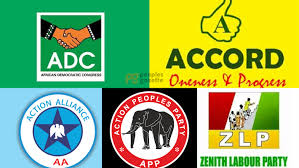
The parties affected by the ruling are the African Democratic Congress (ADC), Accord, Action Alliance (AA), Action Peoples Party (APP), and Zenith Labour Party (ZLP).
The suit was instituted by the National Forum of Former Legislators against INEC, the Attorney-General of the Federation, and the affected political parties. The plaintiffs argued that the parties had failed to secure electoral victories at the federal, state, or local government levels and therefore no longer qualified to remain registered political parties.
At the heart of the dispute is Section 225 of the Constitution, which empowers INEC to deregister political parties that fail to meet specified electoral performance benchmarks. The plaintiffs contended that the electoral fortunes of the affected parties fell below the constitutional threshold, making their continued registration unlawful.
The Attorney-General of the Federation, Lateef Fagbemi (SAN), reportedly supported the suit and urged the court to grant the reliefs sought.
Justice Lifu agreed with the plaintiffs’ arguments and ordered INEC to take the necessary steps to enforce the constitutional provisions. The judgment also restrains the affected parties from participating in future elections unless the decision is overturned on appeal.
The ruling comes at a politically sensitive period as preparations intensify for the 2027 general elections and the forthcoming off-cycle governorship elections in Ekiti and Osun states. Political observers say the judgment, if implemented immediately, could trigger significant disruptions across the electoral landscape.
Of particular interest is the potential impact on high-profile political figures associated with some of the affected parties. The ADC has recently attracted national attention following the emergence of former Vice President Atiku Abubakar as a leading figure within the party’s platform. Similarly, Accord has become a vehicle for prominent political actors in various states.
Legal analysts note that the judgment is unlikely to mark the end of the matter. The affected parties are expected to challenge the decision at the Court of Appeal, potentially setting the stage for a constitutional battle over the powers of INEC, the interpretation of Section 225, and the rights of political parties to continued registration.
The case also revives a long-running debate over Nigeria’s multiparty democracy. Supporters of stricter deregistration policies argue that many registered parties exist only on paper and contribute little to democratic development. Opponents, however, warn that reducing the number of parties could weaken political competition, limit voter choices, and strengthen the dominance of larger political blocs.
For now, attention shifts to INEC and the appellate courts as politicians, candidates, and party supporters await the next chapter in a legal contest that could reshape the contours of Nigeria’s electoral system ahead of crucial elections.