


By James
Kindly share:
Fresh panic has swept across Nigeria following a brazen and deadly attack on the Ore–Benin Expressway, one of the country’s most critical transport corridors, where suspected gunmen ambushed a commercial bus operated by GUO Transport, killed the driver, and abducted several passengers into nearby bush.
The incident, which reportedly occurred in the early hours of Monday, has once again exposed the fragile state of security on Nigeria’s highways.
Eyewitnesses recount a terrifying scene: the bus, said to be travelling from Lagos to the East, was suddenly intercepted by armed men who opened fire without warning.
The driver was fatally shot, and the passengers, thrown into chaos and fear, were forced out of the vehicle and marched off the road into surrounding forest areas.
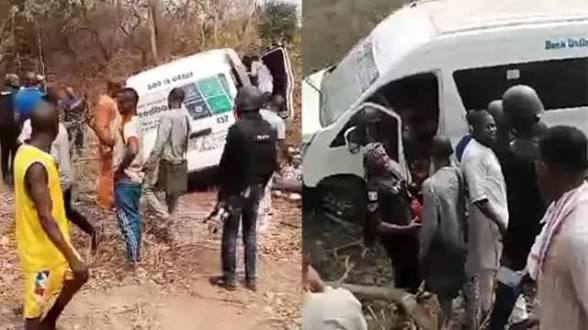
Videos circulating online capture the chilling aftermath. The bus stood abandoned with its doors flung open, luggage strewn across the expressway, and stunned onlookers struggling to process what had just occurred.
Witnesses described the attackers as calm and coordinated, operating with an unsettling sense of control as they carried out the assault and disappeared into the bush without immediate confrontation.
The Ore–Benin Expressway has, for years, been a notorious flashpoint for kidnappings and violent robberies. Linking the commercial nerve centre of Lagos to the South-South and South-East regions, the road is heavily trafficked daily by commuters, traders, and transport companies. Yet its strategic importance has also made it a recurring target for criminal networks who exploit its long stretches of poorly secured terrain. Thick vegetation, isolated segments, and gaps in rapid-response security coverage have created conditions in which attackers can strike and vanish with alarming ease.
Despite the presence of security checkpoints along the route, critics argue that these measures have done little to deter increasingly sophisticated criminal operations.
In recent years, Nigeria has witnessed a troubling expansion of kidnapping-for-ransom activities beyond rural communities into major highways, turning routine travel into a high-risk undertaking. What was once seen as sporadic violence has evolved into a persistent threat, feeding public anxiety and eroding confidence in road transportation.
The sad incident has sparked outrage among citizens, many of whom are demanding immediate and decisive action. Security analysts warn that without a coordinated overhaul of highway policing, featuring intelligence-led patrols, aerial surveillance, and rapid-response units, such attacks may continue unabated.
For many Nigerians, the question is no longer whether these incidents will occur, but where and when the next one will strike.
This latest attack adds to a growing list of violent episodes that have transformed Nigeria’s highways into zones of uncertainty.
Beyond the immediate tragedy, it underscores a broader crisis: a nation grappling with the challenge of securing movement within its own borders. Until concrete measures are implemented and sustained, the fear now gripping travellers may remain a defining feature of road journeys across the country.