
By Amah
Kindly share:
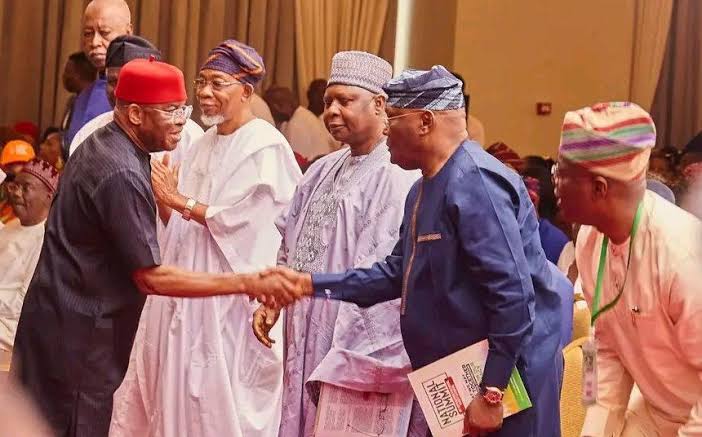
Nigeria’s opposition landscape may be on the cusp of its most consequential realignment in years, as leading political figures and parties closed ranks in Ibadan with a clear message: the dominance of the ruling All Progressives Congress (APC) must be challenged, or the country risks sliding into a de facto one-party state.
At a high-level national summit hosted by Oyo State Governor Seyi Makinde, an array of political heavyweights, including Atiku Abubakar, Rabiu Musa Kwankwaso, Rotimi Amaechi, Peter Obi, and Rauf Aregbesola, converged to chart a unified path toward the 2027 general elections. The gathering, rich in symbolism and strategy, produced a communiqué that blended defiance, urgency, and a calculated shift toward coalition politics.
Reading the communiqué, Peoples Democratic Party (PDP) factional chairman Taminu Turaki struck a combative tone, declaring that the opposition would resist “all machinations” aimed at imposing a one-party system, insisting instead on the preservation of Nigeria’s multiparty democracy. Despite what they described as mounting pressure and political manoeuvring by the ruling party, the opposition leaders affirmed their readiness to contest the 2027 elections across all levels.
But beyond rhetoric, the most significant outcome of the summit was a strategic pivot: a commitment to work toward fielding a single presidential candidate. It is a recognition of a hard political truth, fragmentation has cost the opposition dearly in past elections, particularly in 2019 and 2023, where divided tickets ultimately strengthened the APC’s hold on power. This time, the opposition appears determined to avoid repeating history.
The Ibadan meeting, convened under the influence of Makinde and African Democratic Congress (ADC) National Chairman David Mark, is widely seen as the strongest indication yet of a looming mega alliance. The idea is simple but politically delicate: consolidate influence, harmonise ambitions, and present a unified front capable of mounting a credible challenge against what many at the summit described as an entrenched ruling structure.
Yet, even as unity is proclaimed, the underlying tensions are unmistakable. The race for a potential joint ticket is already shaping up to be fiercely competitive, with figures like Atiku Abubakar, Rotimi Amaechi, and Peter Obi representing divergent political bases, ideologies, and regional calculations. Managing these ambitions without fracturing the coalition will be the opposition’s first real test.
Beyond electoral arithmetic, the summit also amplified concerns about Nigeria’s democratic health. The communiqué openly questioned the neutrality of the Independent National Electoral Commission (INEC), calling for the removal of its chairman, Joash Ojo Amupitan, over alleged bias in favour of the APC. It warned that his continued tenure could undermine electoral credibility and even trigger national instability, an assertion that underscores the deep mistrust between the opposition and the electoral body.
The opposition further called on the National Assembly to urgently review the Electoral Act 2026, arguing that certain provisions threaten the integrity of elections. It also decried what it described as political repression, demanding the release of detained politicians and an end to harassment over bailable offences. In addition, the parties criticised recent INEC guidelines as restrictive and called for an extension of the deadline for party primaries.
In his address, Makinde framed the moment as a slow-burning crisis rather than an abrupt collapse. Democracy, he warned, is rarely destroyed overnight; it is weakened gradually through the erosion of competition and the shrinking of political space. Without a viable opposition, he argued, democracy becomes hollow, retaining its name but losing its substance. His message was clear: Nigeria must not drift into a system where choices exist only on paper.
Makinde also sought to temper perceptions of political conspiracy, insisting that the summit was not a gang-up against any individual, but rather a response to a broader national concern. Democracy, he said, must be defined by real alternatives, not symbolic participation.
Political economist Pat Utomi added an economic dimension to the debate, painting a stark picture of widening inequality and systemic dysfunction. Drawing from personal experience, he contrasted the rising cost of living with the harsh reality of millions surviving on meagre incomes, calling the disparity not just troubling, but absurd. For Utomi, Nigeria’s crisis is not merely economic; it is deeply moral, rooted in leadership failure and the absence of coherent national direction.
He lamented the country’s overdependence on oil, the neglect of other productive sectors, and the lack of policy frameworks tailored to Nigeria’s realities. Yet, he stopped short of fatalism, expressing cautious optimism that with the right leadership and values, the country could still reverse its trajectory.
David Mark, in his intervention, elevated the stakes even further, describing the moment as a “national rescue mission.” He painted a grim picture of insecurity, citing thousands of conflict-related deaths and daily incidents of killings and abductions. According to him, Nigeria is a nation in distress, yet governed with a troubling sense of normalcy.
Mark accused the ruling APC of undermining democratic choice and weakening opposition structures, warning that the drift toward a one-party state is no longer hypothetical but unfolding in real time. His critique of INEC was particularly pointed, likening the electoral body to a referee wearing the jersey of one of the competing teams, a metaphor that captures the depth of opposition distrust.
For him, the battle ahead transcends party lines. It is, in his words, a contest between the ruling party and the Nigerian people, a framing designed to reposition the opposition not merely as political actors, but as representatives of a broader national struggle.
As 2027 approaches, the Ibadan summit may well prove to be a defining moment. It signals a recognition among opposition forces that survival, and relevance, depends on unity, discipline, and strategic clarity. Whether this emerging coalition can withstand internal rivalries, negotiate power-sharing, and present a truly unified ticket remains uncertain.
What is certain, however, is that the era of fragmented opposition politics is being openly challenged. The message from Ibadan is unambiguous: the stakes are too high for division, and the battle for Nigeria’s democratic soul has already begun.