

By James
Kindly share:
The United States has quietly redeployed military assets to Nigeria, including advanced surveillance drones and about 200 personnel, in a renewed effort to support the country’s battle against insurgency in the North-East.
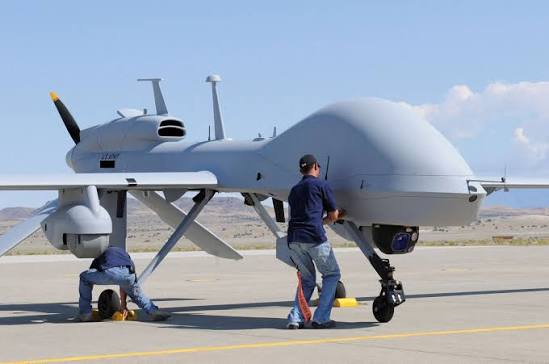
According to officials from both Nigeria and the U.S. who spoke to Reuters, the deployment centres on intelligence gathering rather than combat operations. The U.S. troops are not embedded with Nigerian frontline forces, while the drones identified as MQ-9 Reapers, are tasked strictly with surveillance and reconnaissance missions, not airstrikes.
A U.S. defence official described the move as a collaborative response to a “shared security threat,” emphasizing that the deployment was made at Nigeria’s request.
Nigeria’s Defence Headquarters confirmed the development, noting that the American assets are currently operating from an airfield in Bauchi State.
Major General Samaila Uba, Director of Defence Information, stated that the partnership is already yielding results through a newly established joint intelligence structure.
“This support builds on the US-Nigeria intelligence fusion cell, which continues to provide actionable intelligence to our field commanders,” Uba said, stressing that U.S. personnel remain in a strictly non-combat, advisory capacity.
The renewed U.S. presence in Nigeria comes against the backdrop of evolving security dynamics across West Africa’s Sahel region, where Islamist insurgencies have expanded in both scale and sophistication.
For years, the U.S. maintained a significant counter-terrorism footprint in neighbouring Niger, operating a $100 million drone base that hosted roughly 1,000 troops. From there, American forces monitored militant activity across a vast stretch of the Sahel, including threats spilling into Nigeria.
However, that arrangement collapsed in 2024 after Niger’s military junta ordered the withdrawal of U.S. forces, forcing Washington to reassess its regional security strategy.
Nigeria, Africa’s most populous nation, has long battled extremist groups, such as Boko Haram and its offshoot, Islamic State West Africa Province, ISWAP. Despite years of military campaigns, these groups have continued to launch deadly attacks, particularly in the North-east.
The closure of the Niger base created a surveillance gap in the region, one that this new deployment to Nigeria appears designed to fill.
Analysts say the move signals a recalibration of U.S. counter-terrorism strategy in West Africa, with Nigeria emerging as a central partner. By focusing on intelligence sharing rather than direct combat, Washington aims to strengthen local capacity while avoiding deeper military entanglement.
For Nigeria, the partnership offers a technological edge in tracking insurgent movements, especially in difficult terrains where militants have historically exploited gaps in surveillance.
While officials insist the mission is limited in scope, the development underscores the growing urgency of the security crisis in the region, and the increasing reliance on international collaboration to contain it.