


By Anthony Iwuoma
Kindly share:
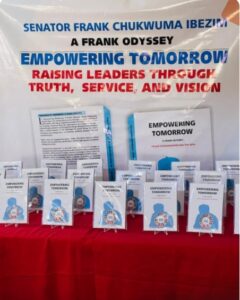
Senator Frank Chukwuma Ibezim’s book is a compelling blend of political memoir, civic guide, and leadership manifesto, offering readers both an insider account of navigating Nigeria’s political landscape and practical lessons on ethical leadership, grassroots engagement, and democratic participation. Through personal narrative, historical analysis, and actionable guidance, Ibezim emphasises resilience, integrity, and the transformative power of informed civic engagement.
The book has 13 chapters in all, spread across 188 pages.
The Introduction sets the stage by defining politics as the process through which groups make collective decisions, whether in local communities or at the national level. Ibezim, the former Senator, who represented Imo North Senatorial District in the National Assembly, in the last dispensation emphasises that politics is not merely about governments or politicians; it encompasses the laws we follow, the policies that govern society, and the institutions that allocate resources. By explaining politics as a societal process, he underscores its pervasive influence, affecting education, healthcare, employment, human rights, and the environment.
A central theme of the Introduction is the need for change. Persistent challenges in African governance, corruption, poor infrastructure, and economic inequality, demonstrate that political systems must evolve to serve citizens effectively. Ibezim highlights the relevance of youth engagement, arguing that decisions made today will directly shape their future. His personal experience in the struggle for the Imo North senatorial seat illustrates how political processes can be complex, involving elections, party dynamics, and legal proceedings. By connecting these abstract concepts to lived experiences, the chapter underscores the importance of civic awareness, participation, and perseverance.
This section lays a foundation for understanding governance, leadership, and citizen responsibility, stressing that politics is not merely theoretical but directly consequential.
Chapter 1: The Basics of Democracy
Chapter 1 provides a foundational introduction to democratic governance, emphasizing principles, processes, and citizen responsibilities. Ibezim presents democracy as a system where power resides ultimately with the people, exercised directly or through elected representatives. The chapter highlights equality, freedom, and justice, explaining how these principles ensure citizens’ voices shape governance.
A notable strength is the chapter’s clarity and accessibility. Complex concepts such as the roles of political parties, the significance of citizen participation, and the structure of Nigerian elections are explained in simple, digestible terms. By outlining local, state, and national elections, Ibezim shows how governance operates across multiple tiers, illustrating how each level impacts citizens’ daily lives. Step-by-step explanations of voter registration, polling procedures, and post-election petitions provide practical guidance for first-time voters and young citizens.
Importantly, Ibezim frames elections not only as procedural events but as ethical and societal instruments for influencing public policy, holding government accountable, and shaping the nation’s future.
While largely descriptive and introductory, the chapter successfully establishes a clear understanding of democratic principles. Its limited critique of systemic challenges, such as electoral malpractice or corruption, presents an area for further exploration. Nevertheless, the chapter serves as a valuable entry point for students, first-time voters, and anyone seeking a practical understanding of democracy in Nigeria.
Chapter 2: Party Primaries and Campaigning
Chapter 2 delves into the internal mechanisms of democratic politics, focusing on party primaries and campaign strategies. Ibezim explains the purpose and types of primaries, harping on their role in selecting credible candidates and fostering internal party democracy. The chapter highlights the empowerment of party members and the energising effect of participatory processes on political bases.
Drawing from personal experience, Ibezim details his campaign for the Imo North senatorial seat, including grassroots engagement across 64 wards, constituent consultations, and community listening exercises. This narrative demonstrates that effective campaigning is about understanding communities, building trust, and fostering accountability. The emphasis on empathy and accessibility underscores a leadership philosophy rooted in service rather than ambition.
The chapter candidly addresses systemic challenges, including financial barriers, intra-party conflicts, misinformation, electoral violence, and legal hurdles. Ibezim recounts his experiences navigating 28 court cases, demonstrating the resilience, legal acumen, and persistence necessary for political success in Nigeria. Additionally, the discussion of electoral reforms underscores the need for transparency, fairness, and accountability.
A potential limitation is the dense detail on legal disputes and campaign logistics, which may overwhelm some readers. Comparative insights from other regions or campaigns could have broadened the analytical scope. However, the chapter succeeds as a practical, experience-driven guide to party politics, combining procedural clarity with motivational guidance for aspiring politicians and civic educators.
Chapter 3: The Generational Change
Chapter 3 examines the transformative potential of generational change, emphasising youth engagement and fresh leadership perspectives. Ibezim illustrates how new generations bring energy, innovative ideas, and values that can reshape communities and political landscapes. Drawing from his senatorial experience, he demonstrates how initiatives in education, agriculture, and community development produce tangible improvements in people’s lives.
The chapter is motivational, encouraging young readers to act locally and think globally. Ibezim shows that one does not need formal office to effect change, highlighting digital training programmes, classroom library projects, and community initiatives, as examples of practical interventions that cultivate future leaders.
Historical and contemporary case studies enrich the chapter, which emphasises lessons of persistence, resilience, and solidarity, showing that meaningful change requires sustained effort. While dense with examples, the narrative effectively motivates youth participation and illustrates the present and ongoing potential of generational leadership. A more detailed discussion of structural barriers, such as financial constraints or limited access to platforms, could have enhanced the analysis, but overall, the chapter is inspirational and instructional.
Chapter 4: Personal Experiences and Leadership
Chapter 4 explores the intersection of personal experience, memory, and leadership, stressing that effective governance is grounded in lived experiences and moral reflection. Ibezim illustrates how his journey, from education reform to youth empowerment and community security initiatives, informs decision-making and fosters empathetic leadership.
Faith emerges as a sustaining ethical compass, guiding actions without imposing dogma. This integration of personal conviction with professional responsibility reinforces the importance of principled decision-making in political life. The chapter is accessible to young readers and emerging leaders, demonstrating that leadership is cultivated through reflection, service, and moral grounding.
Chapters 5–8: Grassroots Engagement, Campaigns, and Ethical Governance
Chapters 5 through 8 provide practical guidance on grassroots political engagement, modern campaign strategies, and ethical leadership. Ibezim emphasises that meaningful change begins with trust, collaboration, and integrity at the community level. He examines the realities of political alliances, godfatherism, and systemic corruption, offering guidance on maintaining ethical standards while navigating complex political landscapes.
Campaign strategy in the digital age is a key focus. Ibezim discusses the complementation of social media, data-driven tools, and traditional grassroots mobilisation, stressing that campaigns should educate, build dialogue, and foster long-term relationships. Ethical campaigning, fact-based messaging, respectful discourse, and transparent communication, is presented as both a moral imperative and a strategic advantage.
Chapters 7 and 8 address inclusivity, civic responsibility, and corruption. Ibezim reframes politics as a shared civic project, encouraging youth, women, and marginalised groups to participate actively. Trust-building, transparency, and responsiveness are highlighted as central to sustaining citizen confidence. The chapters balance aspirational visions with the realities of entrenched systemic challenges, promoting civic activism and institutional reform.
Propaganda and Legal Challenges: Case Study
A standout section examines Ibezim’s election and the challenges posed by propaganda, misinformation, and legal disputes. Accusations regarding certificate forgery and name discrepancies are dissected, clarifying procedural and cultural nuances. The Supreme Court’s ruling in Ibezim’s favour underscores the importance of due process, judicial rigour, and resilience in leadership.
The narrative extends beyond personal vindication to explore systemic political manipulation, highlighting the need for collective responsibility, ethical reform, and citizen vigilance. This section is instructive for students of politics, law, and governance, illustrating the interplay between individual resilience, legal institutions, and civic ethics.
Chapters 9–11: Civic Engagement and Voter Education
These chapters provide detailed guidance on voter education, civic participation, and political involvement. Chapter 9 emphasises informed voting, critical thinking, and evaluating candidates and policies. Ibezim advocates questioning sources, recognising bias, and considering long-term implications in an era of misinformation.
Chapters 10 and 11 break down political engagement into achievable steps; student leadership, community initiatives, advocacy, and local governance, demonstrating that politics is accessible and service-oriented. Resilience, ethical conduct, and sustained community involvement are emphasised, framing leadership as a lifelong commitment. The chapters empower young readers to become active agents of change rather than passive observers.
Chapter 12 of Senator Frank Ibezim’s book is a forward-looking reflection on leadership, public service, and the ongoing responsibility of community engagement. Titled “What Comes Next,” the chapter stresses that leadership is not confined to holding office but is a lifelong commitment to societal development and the empowerment of others. Ibezim uses his personal journey and the work of the Senator Frank Ibezim Foundation to illustrate how sustained efforts in education, agriculture, infrastructure, and youth empowerment can create lasting impact.
Education is central to Ibezim’s vision for the future. Through initiatives like the classroom library project across his senatorial zones, he promotes reading culture, family involvement in learning, and access to quality educational resources. Beyond infrastructure, the chapter underscores teacher training, integration of technology, and a holistic approach to grassroots education. By investing in education, Ibezim demonstrates the foundational role it plays in shaping future leaders and innovators.
Agriculture is highlighted as both an economic driver and a vehicle for community empowerment. The chapter details programmes supporting farmers through modern techniques, access to technology, and market linkages. Notably, local rice and palm oil mills exemplify strategies that enhance productivity, reduce post-harvest losses, create employment, and retain economic benefits within communities. Ibezim frames sustainable agriculture as essential for food security, economic resilience, and environmental stewardship.
Youth empowerment emerges as a key theme, reflecting Ibezim’s belief that today’s youth are tomorrow’s leaders. The chapter insists on active participation in civic and political life, mentorship programmes, vocational and entrepreneurial training, and creating platforms for young people to contribute meaningfully. By fostering knowledge, skills, and confidence, these initiatives aim to cultivate informed, ethical, and dedicated future leaders capable of driving positive societal change.
Infrastructure and community development are also foregrounded. Ibezim emphasises projects that provide essential services, roads, boreholes, solar lighting, schools, and healthcare facilities, creating environments where communities can thrive. Coupled with his advocacy for inclusive leadership and public service integrity, these initiatives demonstrate a holistic approach to sustainable community development.
A central message of the chapter is that leadership transcends political tenure. Ibezim illustrates how commitment to service before, during, and after holding office reflects a true dedication to public good. Integrity, honesty, and long-term vision are presented as essential qualities for young people entering public service, with the potential to combat corruption, inspire trust, and catalyse national progress.
In conclusion, Chapter 12 is both inspirational and instructive. It positions leadership as a lifelong endeavour rooted in service, community engagement, and empowerment. Through education, agriculture, infrastructure, and youth-focused programmes, Ibezim offers a practical blueprint for creating sustainable impact. The chapter challenges readers, especially young Nigerians, to reflect on their own contributions and embrace a vision of active, ethical, and inclusive leadership for the future.
Chapter 13 of Senator Frank Ibezim’s book offers a practical and inspiring exploration of sustainable development, demonstrating how targeted initiatives in youth empowerment, education, gender equality, agriculture, and community engagement can drive lasting societal transformation. Grounding his analysis in the United Nations Sustainable Development Goals SDGs, Ibezim links global priorities to local action, providing a roadmap for emerging leaders and policymakers alike.
The chapter begins by contextualising sustainable development as meeting the needs of the present without compromising the ability of future generations to meet theirs. Ibezim emphasises that sustainability requires balancing economic growth, social inclusion, and environmental stewardship. The SDGs, he notes, provide a structured framework to address global challenges, from poverty and hunger to education, gender equality, and climate action. By framing these goals in actionable terms, Ibezim demonstrates that youth engagement is central to achieving them, positioning young people as agents of innovation and future leadership.
Youth empowerment emerges as a central theme. Ibezim argues that young people represent both the present and future of governance, innovation, and societal progress. Through education, leadership training, civic engagement, and entrepreneurship, youth can actively influence community development and policy outcomes. Ibezim highlights strategies, such as leadership development programmes, participatory decision-making, and targeted entrepreneurship initiatives, particularly in agriculture and technology. These efforts not only equip young people with skills but also cultivate a sense of responsibility and agency, reinforcing the notion that sustainable development depends on inclusive participation.
Gender equality and the reduction of societal inequalities are presented as essential components of sustainable development. Ibezim stresses that inclusive leadership, which reflects the diversity of society, produces policies that are more equitable and responsive. His initiatives, leadership programmes for women, advocacy for gender-inclusive policies, and public awareness campaigns, demonstrate practical approaches to integrating equality into governance. By promoting inclusive leadership, Ibezim underscores how marginalised groups can actively contribute to societal progress, ensuring that development benefits are broadly shared.
Sustainable agriculture is another pillar highlighted in the chapter. Ibezim states that agricultural development is critical to food security, economic growth, and environmental protection, especially in rural areas. He advocates training farmers in eco-friendly techniques, supporting smallholder enterprises, and promoting climate-resilient farming. These initiatives exemplify how local interventions in agriculture can simultaneously address hunger, improve livelihoods, and protect the environment, aligning directly with SDGs related to zero hunger, economic growth, and climate action.
Education, Ibezim argues, underpins all other development efforts. Quality education equips individuals with the skills, knowledge, and confidence to innovate and contribute meaningfully to society. His strategies, improving school infrastructure, introducing classroom libraries, and investing in teacher training, highlight the importance of equitable access and lifelong learning. By emphasising both access and quality, Ibezim demonstrates education’s pivotal role in breaking cycles of poverty and inequality.
Community engagement serves as the final connecting thread. Ibezim proposes empowering communities to implement local initiatives that integrate youth leadership, gender equality, education, and sustainable agriculture. By fostering participatory, bottom-up approaches, communities become both drivers and beneficiaries of development, creating sustainable systems that can adapt and thrive over time.
Chapter 13 is particularly effective in translating global SDG frameworks into concrete local actions. Its strengths lie in its practical guidance, integration of youth and community participation, and clear examples drawn from Ibezim’s own initiatives. Minor limitations include the ambitious scope, which sometimes limits in-depth exploration of individual SDGs. Nevertheless, the chapter succeeds in demonstrating the interconnectedness of youth empowerment, education, equality, agriculture, and community engagement in achieving sustainable development.
In conclusion, Chapter 13 exemplifies how strategic leadership and community-focused interventions can drive tangible progress. Senator Frank Ibezim’s approach, grounded in youth empowerment, inclusive leadership, sustainable agriculture, and quality education, offers a replicable model for achieving the SDGs at the local level. The chapter inspires and equips readers, particularly young leaders, to translate global goals into actionable, community-driven initiatives, reinforcing the central message that sustainable development is a shared responsibility requiring inclusive, participatory, and ethically grounded leadership.
*Conclusion and Overall Assessment
Senator Frank Ibezim’s book is both a political memoir and a civic manual. Its strengths include authenticity, practical guidance on political participation, and ethical, value-driven approaches to leadership. The book comprehensively addresses aspirational and systemic aspects of Nigerian politics, including corruption, propaganda, and civic engagement. Faith and morality are integrated as guiding principles, providing readers with frameworks for ethical decision-making.
Weaknesses include thematic repetition, limited critical self-reflection, and occasional structural shifts between memoir, guide, and Q&A formats. Some legal and technical explanations may challenge readers unfamiliar with Nigeria’s electoral or judicial systems. Nevertheless, these are minor relative to the book’s contributions.
Overall, the book effectively inspires civic responsibility, promotes ethical leadership, and equips readers with practical tools for political engagement. The book employs a Q&A format, an approach that enhances engagement and encourages readers to reflect on their civic responsibilities. Also, by combining personal experience, societal analysis, and forward-looking vision, Ibezim models leadership that is ethical, resilient, and impact-driven. The work encourages readers, especially young Nigerians, to participate meaningfully in politics, challenge systemic corruption, and contribute to national transformation. Leadership, as presented here, is framed not as the pursuit of power but as a lifelong commitment to service, integrity, and societal impact.
Senator Frank Ibezim’s book is a must-read because it combines a vivid political memoir with practical guidance on ethical leadership, civic engagement, and generational change, offering both inspiration and actionable strategies. It equips readers, especially young Nigerians, with the knowledge, tools, and moral framework to participate meaningfully in politics and community development. Through real-life experiences, historical examples, and forward-looking insights, the book demonstrates how leadership grounded in integrity, resilience, and service can drive sustainable societal transformation.