
By Amah
Kindly share:
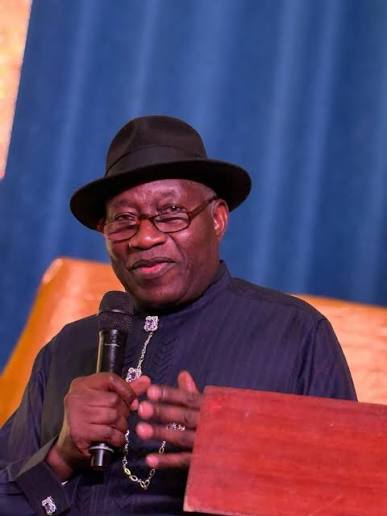
Nigeria’s political landscape may be heading for another dramatic realignment ahead of the 2027 general elections, as former President Goodluck Jonathan has openly hinted at a possible return to the presidential race.
The development is already stirring intense debate across the country’s opposition circles and threatening the ambitions of key political figures positioning themselves within the emerging coalition movement around the NDC.
Jonathan’s latest remarks in Abuja came after a group of supporters stormed his office, urging him to contest the next presidential election.
While the former president stopped short of making a formal declaration, his statement that he would “consult widely” has been interpreted by many political observers as the clearest indication yet that he may be testing the waters for a possible comeback.
For months, speculations had persisted that powerful political stakeholders searching for a consensus figure capable of confronting the ruling establishment were quietly considering Jonathan as a unifying option. His growing closeness to influential actors believed to be sympathetic to the Nigerian Democratic Congress, NDC, has further fueled reports that the former president could emerge as a central figure in the coalition talks ahead of 2027.
Jonathan’s political relevance has remained surprisingly strong years after leaving office in 2015. Unlike many former African leaders whose influence fades after power, the Bayelsa-born politician has managed to cultivate an image of moderation, diplomacy, and electoral civility. His concession to then opposition candidate Muhammadu Buhari after the 2015 election remains one of the most celebrated democratic moments in Nigeria’s modern political history.
Since leaving office, Jonathan has built a continental reputation as an election observer and peace advocate, participating in election monitoring missions across Africa. That international image, combined with dissatisfaction among many Nigerians over worsening insecurity, economic hardship, and political polarisation, has helped revive conversations about whether the former president could once again become a compromise candidate acceptable to different regions and political blocs.
But Jonathan’s potential entry into the race may also ignite serious tensions within the opposition coalition currently trying to reposition itself under the NDC platform. Both former presidential candidates, Peter Obi and Rabiu Kwankwaso, are widely believed to be weighing their own presidential ambitions within the broader coalition arrangement.
Their supporters have increasingly viewed the NDC movement as a possible vehicle for a united opposition challenge in 2027.
Jonathan’s emergence, however, could fundamentally alter those calculations.
Unlike Obi and Kwankwaso, whose political appeal remains heavily regionalised despite national followings, Jonathan possesses a unique political identity that cuts across several divides. He enjoys sympathy in parts of the South-South and South-East, retains goodwill among segments of northern political elites, and may also attract moderates uncomfortable with confrontational politics.
This reality could create an uncomfortable dilemma for Obi and Kwankwaso camps. A Jonathan candidacy may force both men into difficult negotiations over zoning, coalition leadership, and political concessions.
Some analysts already believe that sections of the political establishment may prefer Jonathan precisely because he is perceived as less disruptive and more predictable than some of the newer opposition figures, reshaping Nigeria’s political space.
There is also the delicate issue of generational expectations. Obi’s movement drew significant energy from younger Nigerians seeking a break from the old political order, while Kwankwaso continues to command a fiercely loyal grassroots base, particularly in northern Nigeria.
Jonathan’s return could, therefore, trigger debates about whether Nigeria is genuinely moving forward politically or simply recycling familiar faces in moments of national uncertainty.
Still, Jonathan’s comments appeared carefully calibrated. Rather than sounding like an active candidate, he framed his intervention around patriotism, peaceful elections, youth participation, and national stability. Yet in Nigeria’s political environment, such language often serves as the opening chapter of a larger political negotiation.
By saying “presidential race is not a computer game” and promising to “consult widely,” Jonathan may have deliberately left enough ambiguity to sustain political momentum without prematurely provoking rivals or opponents.
As coalition talks intensify ahead of 2027, one thing is becoming increasingly clear: Jonathan’s shadow now hangs heavily over the opposition realignment process. Whether he eventually contests or not, his mere presence in the conversation could reshape alliances, unsettle presidential hopefuls, and redefine the battle for Nigeria’s next political future.