
By Amah
Kindly share:
Nigeria’s political landscape is once again shifting, quietly but significantly.
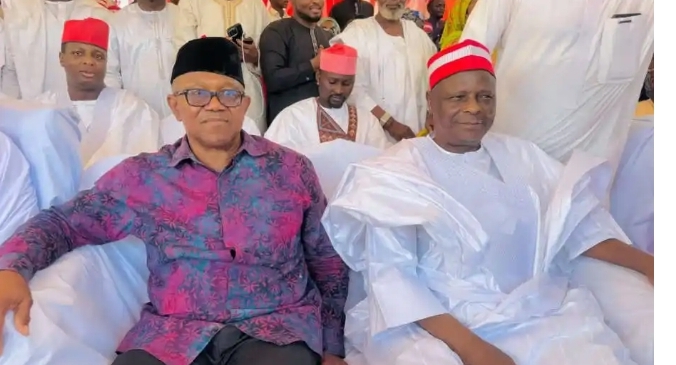
A Sallah visit by Peter Obi to Rabiu Musa Kwankwaso in Kano has evolved from a routine courtesy call into a potential game-changer, setting the stage for what could become the most consequential opposition realignment ahead of the 2027 general elections.
Far from symbolic, the meeting has rekindled conversations about unity among fragmented opposition blocs, raising a central question: can old rivals finally align to challenge the dominance of the All Progressives Congress (APC)?
To understand the weight of this meeting, one must revisit 2023, a defining election where both Obi and Kwankwaso rode powerful but separate waves. Obi’s Obidient Movement energised millions of young Nigerians under the Labour Party, while Kwankwaso’s Kwankwasiyya structure held firm across northern strongholds through the NNPP. Yet, despite their complementary strengths, both camps failed to agree on a joint ticket.
Disputes over leadership hierarchy, party supremacy, and presidential candidacy ultimately derailed what could have been a formidable third force. The consequence was decisive: a divided opposition and the emergence of Bola Tinubu as president under the APC. Today’s renewed engagement suggests a sobering lesson has been learned, and perhaps, a second chance is being carefully negotiated.
Emerging details point to a broader orchestration beyond the Kano meeting. Former President Olusegun Obasanjo is reportedly spearheading quiet but strategic efforts to unify opposition figures into a single, viable coalition. Insiders reveal that a committee initiated in late 2025 has already opened channels between Obi and Kwankwaso, with discussions extending to key political heavyweights, such as Atiku Abubakar and Rotimi Amaechi. The objective is clear: avoid a repeat of 2023 by consolidating votes, harmonising ambitions, and presenting Nigerians with a credible alternative platform, potentially anchored by the ADC. For Obasanjo, this may well be a final political intervention, an attempt to recalibrate Nigeria’s democratic balance by strengthening opposition capacity.
Within Kwankwaso’s political base, especially in Kano, there are growing calls for strategic flexibility. Political stakeholders are reportedly urging him to reconsider earlier reservations about alliances, particularly in light of evolving realities within both the ruling party and opposition ranks. Failed overtures from the APC to bring Kwankwaso into its fold have further reinforced the urgency of an alternative path, one that could elevate him within a broader coalition rather than isolate him in a fragmented contest. For Obi, whose support base remains emotionally charged but structurally dispersed, an alliance offers geographical balance and political depth.
Public sentiment appears to be tilting in favour of collaboration. Across political conversations, the idea of an Obi–Kwankwaso alliance is increasingly framed not just as strategy, but necessity. NNPP stakeholders argue that both men represent a generational shift, leaders perceived as more energetic, tested, and in tune with Nigeria’s evolving demands.
For many citizens disillusioned by economic hardship and governance fatigue, this pairing symbolises a break from the old guard.
Yunusa Tanko, a key figure in the Obidient Movement, has confirmed that discussions have been ongoing since 2023, stressing that the coalition must go beyond personalities to include a wider national movement committed to systemic change.
Analysts warn that the urgency of this alliance cannot be overstated. The steady consolidation of power by the APC, bolstered by defections from opposition governors, has raised concerns about the erosion of competitive democracy in Nigeria.
Some observers now describe the Obi–Kwankwaso engagement as the “last viable bridge” for opposition survival, particularly as the Peoples Democratic Party (PDP) struggles with internal fractures and declining influence. Without a unified front, the opposition risks entering 2027 weakened, divided, and ultimately irrelevant.
Standing firmly in the path of any coalition is President Bola Ahmed Tinubu, a politician widely respected for his strategic acumen and deep-rooted influence across Nigeria’s political architecture. His history suggests he will not be a passive observer. From coalition-building to political containment, his playbook is expected to evolve rapidly in response to any credible threat. This sets the stage for a high-stakes contest where strategy, negotiation, and political willpower will determine the outcome long before ballots are cast.
While the Kano meeting has generated excitement, analysts caution against premature celebration. Nigeria’s political history is littered with failed alliances undone by ego, mistrust, and last-minute power struggles.
For Obi and Kwankwaso, the real work lies ahead, moving beyond photo-ops to hard negotiations. Questions around ticket sharing, party structure, and ideological alignment must be resolved with clarity and compromise. Anything less could reduce this moment to yet another missed opportunity.
With inflation biting harder, fuel prices soaring, and insecurity persisting, the Nigerian electorate is increasingly restless. The appetite for change is evident, but translating that sentiment into electoral victory will require more than popularity. It will demand unity.
The Kano convergence may have reopened the door to that possibility. Whether it leads to a historic coalition or collapses under familiar pressures will define not just the fortunes of Obi and Kwankwaso, but the future of opposition politics in Nigeria.