

By Amah
Kindly share:
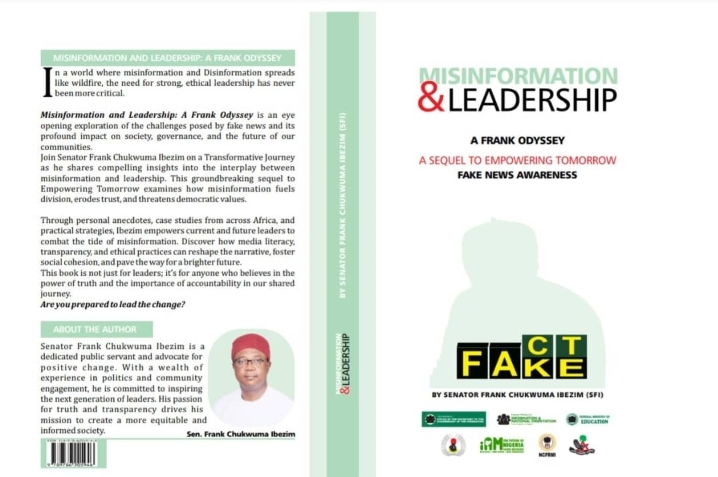
Title: Misinformation and Leadership: Power, Falsehood, and the Battle for Democratic Survival
Author: Senator Frank Chukwuma Ibezim
Publisher: Frank Ibezim Foundation, Abuja
Year: 2024
Reviewer: Tony Iwuoma
In every age, societies have struggled with falsehood. Lies are not a modern invention; they have always accompanied power, ambition, fear, and rivalry. What distinguishes the present era is not the existence of lies, but their velocity, reach, and lethal efficiency.
In today’s digital ecosystem, truth no longer enjoys moral advantage by default; it must compete, aggressively, for attention, survival, and credibility in a marketplace saturated with outrage, conspiracy, algorithmic manipulation, and manufactured certainty.
A single false claim can now travel across continents in seconds, ferment mistrust in hours, and destabilise institutions in days. What once required coordinated propaganda machinery can now be executed with a smartphone, a rumour, and an audience primed for outrage. Misinformation has matured from incidental distortion into a sophisticated instrument of political, economic, and psychological power.
Nowhere is this transformation more dangerous than in fragile or transitional democracies, such as Nigeria’s, where political rivalry intersects explosively with ethnic identity, religious emotion, economic frustration, and unresolved historical grievances. In such environments, falsehood does not merely deceive; it ignites. It radicalises discourse, fractures communities, delegitimises authority, and converts disagreement into hostility. It does not merely distort reality; it re-engineers it.
Against this troubling backdrop, Senator Frank Chukwuma Ibezim’s Misinformation and Leadership, which is a sequel to his earlier book, Empowering tomorrow, emerges not merely as a book, but as an intervention, a deliberate attempt to arrest a national drift toward informational anarchy. It is a work shaped more by experience than abstraction, more by conviction than convenience. At its core, it is an insider’s examination of how misinformation operates within the machinery of politics and governance, and a sober meditation on what leadership must become if democracy is to survive the age of manufactured reality.
A Text Forged in the Furnace of Experience
Misinformation and Leadership is structured into 26 chapters, each functioning as a thematic lens through which the author interrogates falsehood,; its origins, its mechanics, its agents, and its victims. The architecture of the book is deliberate. It moves from conceptual framing to lived experience, and from personal ordeal to institutional and societal implications. This progression mirrors the journey of misinformation itself: from a whisper to a weapon, from an idea to an inferno.
What distinguishes this work from the swelling literature on fake news is its authorial standpoint. Senator Ibezim does not write as a detached academic or a distant moralist. He writes as a participant-observer, a political actor who has confronted misinformation not as theory, but as force. This experiential grounding lends the book moral weight and narrative urgency. It is not merely an argument about misinformation; it is a testimony about what happens when lies acquire power.

From the opening chapters, misinformation is defined with clarity and firmness, not as innocent error, casual exaggeration, or misunderstanding, but as the deliberate distortion of facts to manipulate perception, undermine credibility, and sabotage democratic processes. The author argues persuasively that the digital revolution has collapsed the boundary between rumour and reality. Social media platforms reward speed over accuracy, emotion over evidence, and virality over verification. In such a climate, falsehood often arrives before truth has time to put on its shoes, and by the time correction comes, damage has already been done.
Nigeria as a Case Study in Democratic Vulnerability
While the book draws on global examples, Nigeria remains its central laboratory. The country’s socio-political terrain, defined by ethnic plurality, religious diversity, uneven development, institutional fragility, and contested legitimacy, creates ideal conditions for misinformation to thrive. False narratives flourish where trust is thin and authority is disputed. In such contexts, a lie does not require proof; it merely requires plausibility.
Senator Ibezim is particularly incisive in demonstrating how misinformation exploits identity. Ethnicity becomes a trigger, religion a weapon, and regional history a reservoir of grievance. Political actors, both formal and informal, weaponise these fault lines to discredit opponents, derail policies, and mobilise fear. The result is a public sphere perpetually on edge, where suspicion replaces dialogue and outrage substitutes for evidence.
Nigeria, the book suggests, is not uniquely dishonest; it is uniquely vulnerable. When institutions struggle to command trust, misinformation fills the vacuum. When leadership communication is weak or inconsistent, speculation becomes currency. When citizens feel excluded from power or prosperity, conspiracy offers emotional compensation.
The Personal as Political: When Lies Are Weaponised
The emotional and analytical core of Misinformation and Leadership lies in the author’s account of being falsely accused of links to terrorism. This episode is narrated with restraint and clarity, avoiding melodrama while exposing the anatomy of a destructive lie. A baseless allegation, amplified through digital platforms and whispered through communities, mutated into a threat capable of halting development projects, endangering lives, and poisoning public perception.
What gives this account its force is not its personal nature, but its universality. Senator Ibezim demonstrates how misinformation acquires autonomy once released. It no longer belongs to its originator; it feeds on fear, repetition, and silence. It becomes immune to correction, resistant to evidence, and sustained by emotional investment.
Through this ordeal, the book issues a stark warning: misinformation is not abstract, theoretical, or harmless. It wounds real people, fractures real communities, and carries real consequences. It can destroy reputations built over decades and reverse progress achieved through years of patient effort.
Integrity as Strategy, Not Ornament
One of the book’s most important intellectual contributions is its reframing of integrity. Too often, integrity is treated as a moral accessory, commendable, but impractical in the rough terrain of politics. Senator Ibezim rejects this false dichotomy. In Misinformation and Leadership, integrity is presented as a strategic asset, a leader’s first and most reliable line of defence.
Misinformation thrives where credibility is weak. Leaders who lack transparency, consistency, or ethical grounding are easy prey for falsehood. Conversely, leaders who align words with actions, communicate clearly, submit themselves to accountability, and build reservoirs of trust become harder to dislodge.
Drawing on figures, such as Nelson Mandela, Ellen Johnson Sirleaf, Kwame Nkrumah, and other global leaders, the author demonstrates that history ultimately vindicates those who remain anchored in purpose and principle. These examples are not romanticised; they are deployed as evidence that leadership grounded in integrity may be battered, but it endures.
Importantly, the book does not stop at moral exhortation. It offers practical strategies for confronting misinformation: rapid and factual clarification, documentary evidence, disciplined media engagement, emotional restraint under provocation, and legal redress where appropriate. Silence, the author warns, can be misread as guilt; panic, as weakness. Leadership demands composure.
Inside the Machinery of Modern Propaganda
The book offers a meticulous dissection of propaganda in the digital age. Misinformation, Senator Ibezim explains, relies on familiar techniques: emotional manipulation, selective truth, repetition, fear-mongering, and oversimplification. What has changed is the scale and automation with which these techniques now operate.
Algorithms reward outrage. Bots simulate consensus. Memes compress falsehood into digestible symbols. Echo chambers insulate belief from contradiction. Particularly alarming is the rise of targeted misinformation: false narratives tailored to specific ethnic, religious, or regional audiences to maximise emotional impact.
Against this machinery, the author proposes no naïve optimism. There are no technological silver bullets. The only durable defences, he argues, are critical thinking, verification, ethical journalism, and education. Young people, who dominate digital spaces, are both the most vulnerable to manipulation and the most powerful agents of resistance.
Complicity Across the Information Ecosystem
One of the book’s strengths is its refusal to assign blame simplistically. Traditional media institutions are critiqued for sensationalism and partisan framing that sometimes legitimise false narratives. WhatsApp groups, valuable for social cohesion, are exposed as unregulated rumour mills. Influencers and content creators are challenged for prioritising clicks and monetisation over truth.
Even Diaspora communities are examined with refreshing honesty. Emotional distance, nostalgia, and distrust of local institutions can make them eager consumers, and amplifiers, of unverified claims. Across this ecosystem, the author’s prescription is consistent: communicative power carries ethical responsibility.
The Hidden Casualties of Falsehood
Beyond politics, Misinformation and Leadership returns repeatedly to the human cost of deception. Fake news fractures families, incites hate speech, encourages mob justice, and discourages civic participation. It creates climates of fear in which rational dialogue becomes impossible.
The author’s account of a misrepresented partnership involving the National Commission for Refugees, Migrants, and Internally Displaced Persons (NCFRM) is particularly revealing. What began as misinformation escalated into suspicion, community tension, and the threat of violence. These passages underscore a central truth: misinformation destroys social cohesion long before it topples institutions.
Misinformation as a Development Emergency
Perhaps, one of the book’s most original contributions is its framing of misinformation as a development crisis. False narratives actively undermine progress toward the Sustainable Development Goals, particularly Quality Education (SDG 4) and Peace, Justice, and Strong Institutions (SDG 16). When trust collapses, education falters, partnerships fail, and institutions lose legitimacy.
Development, the book insists, is not only about resources and policy; it is about trust. And misinformation is trust’s most efficient assassin.
Education as the Enduring Antidote
If misinformation is a disease, education is presented as the most sustainable cure. Media literacy, ethical journalism, digital responsibility, and critical inquiry must be embedded within both formal and informal learning systems. Young people, journalists, and content creators are called to a higher civic vocation, not as merchants of outrage, but as guardians of truth.
Leadership, the author insists, must model this discipline. Integrity must be visible, consistent, and costly.
Institutions Under Strain, Leadership Under Test
The book extends its analysis to major institutions, the National Assembly, security agencies, religious bodies, and traditional authorities. Across these sectors, misinformation corrodes legitimacy and weakens authority. Transparency and proactive communication, by contrast, restore confidence.
Preparing Leaders for Permanent Information Warfare
The concluding chapters are urgent and forward-looking. Future leaders, the book argues, must be trained not only in governance and policy, but in digital literacy, crisis communication, emotional intelligence, and collaborative leadership. Information warfare is no longer episodic; it is permanent.
The final message is unmistakable: combating misinformation is a collective obligation. Citizens, leaders, institutions, media, and governments must choose truth deliberately, defend it consistently, and pay the price for it courageously.
Final Verdict
Misinformation and Leadership is not merely a book about fake news. It is a sober meditation on power, responsibility, and moral courage in an age of distortion. Rooted in lived experience and sharpened by ethical clarity, it stands as essential reading for leaders, journalists, educators, policymakers, and citizens who refuse to surrender public life to deception.
In an era when lies travel fast and truth struggles to breathe, Senator Frank Chukwuma Ibezim reminds us that leadership, at its highest calling, is the disciplined, often lonely, but ultimately redemptive defence of truth.
Strengths of the Book
1. Lived Experience as Intellectual Capital
One of the book’s greatest strengths is its grounding in lived experience. Senator Frank Chukwuma Ibezim does not approach misinformation as an abstract phenomenon or a borrowed theory; he writes as someone who has been personally targeted, bruised, and tested by it. This insider perspective lends the book moral authority and narrative urgency. The account of being falsely linked to terrorism is not only compelling but illustrative, transforming misinformation from a conceptual problem into a tangible and human crisis.
2. Contextual Relevance to Fragile Democracies
The book’s focus on Nigeria as a primary case study is a major asset. Rather than overgeneralising from Western media models, it situates misinformation within the realities of a fragile, plural, and distrust-laden democracy. By showing how ethnicity, religion, and regional grievances are exploited, the book offers insights that resonate far beyond Nigeria, extending to many African and Global South democracies facing similar vulnerabilities.
3. Moral Clarity Without Moralism
Misinformation and Leadership succeeds in articulating ethical clarity without descending into sanctimony. Integrity is presented not as a sermon, but as a strategic necessity. The argument that credibility is a leader’s strongest defence against falsehood is persuasive, realistic, and grounded in political reality. This balance between morality and pragmatism strengthens the book’s intellectual credibility.
4. Practical Leadership Guidance
Beyond diagnosis, the book offers concrete leadership strategies for confronting misinformation: Proactive communication, disciplined media engagement, evidence-based rebuttal, emotional restraint, and legal recourse. These prescriptions elevate the work from commentary to a leadership manual, particularly relevant for public office holders, aspirants, and institutional communicators.
5. Multidimensional Treatment of the Problem
The book does not reduce misinformation to social media alone. It examines the complicity of traditional media, influencers, Diaspora communities, religious spaces, and informal communication networks, such as WhatsApp groups. This ecosystem-wide approach reflects a mature understanding of how falsehood circulates and is sustained.
6. Timeliness and Policy Relevance
At a time when digital misinformation is reshaping elections, security narratives, and governance outcomes, the book’s intervention is timely. Its alignment with global development concerns, such as trust in institutions, peacebuilding, and civic education, enhances its policy relevance and makes it useful beyond immediate political contexts.
Weaknesses of the Book
1. Heavy Reliance on Personal Narrative
While the author’s personal experience is a strength, it occasionally dominates the analytical space. Some readers may feel that the book leans too heavily on individual ordeal at the expense of broader empirical data or comparative analysis. A wider range of documented case studies, beyond the author’s experience, could have strengthened the book’s generalisability.
2. Limited Engagement with Empirical Research
The book is conceptually sound but light on quantitative data and academic research. There is minimal engagement with empirical studies on misinformation dynamics, algorithmic amplification, or behavioural psychology. For academic or policy audiences, stronger integration of data, statistics, and scholarly references would enhance analytical depth.
3. Broad Solutions, Limited Structural Detail
While the proposed remedies, education, integrity, media literacy, ethical leadership, are compelling, they are sometimes presented at a high level of abstraction. The book could benefit from more detailed institutional roadmaps: how exactly should governments regulate misinformation without threatening free speech? How should platforms be held accountable in weak regulatory environments?
4. Underdeveloped Role of Technology Platforms
The analysis of social media platforms and algorithms, though accurate, remains largely descriptive. There is limited exploration of platform governance, regulatory models, or comparative international responses to digital misinformation. Deeper engagement with the responsibility and power of tech companies would strengthen the book’s policy dimension.
5. Occasional Normative Bias
The book’s strong ethical posture, while admirable, may occasionally blur analytical distance. Critics may argue that the author’s proximity to political power risks conflating personal vindication with structural critique. A more explicit acknowledgment of this tension would further strengthen the book’s intellectual transparency.
6. Audience Ambiguity
At times, the book appears unsure whether it is addressing political leaders, the general public, or policy experts. While this broad appeal is an advantage, it also creates moments of uneven depth, some sections may feel too introductory for experts and too dense for lay readers. Clearer audience signalling could improve coherence.
Overall Assessment
Misinformation and Leadership is a serious, timely, and morally grounded contribution to the discourse on democracy in the digital age. Its greatest strength lies in its fusion of lived political experience with ethical reflection and practical leadership guidance. Its weaknesses stem largely from limited empirical breadth and structural specificity rather than conceptual flaws.
Ultimately, the book succeeds not because it claims to solve misinformation, but because it forces leaders and citizens alike to confront their responsibility within it. In an age where falsehood is cheap and outrage is profitable, this insistence on integrity as both moral compass and political strategy is the book’s most enduring contribution.