
By Amah
Kindly share:
The battle for the 2027 presidency has opened a fresh political front in the South-east, with two competing camps advancing radically different strategies for achieving what both describe as the ultimate prize for Ndigbo: the presidency of Nigeria.
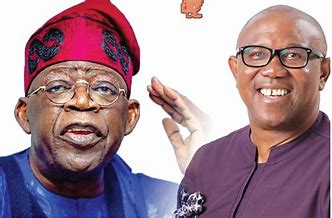
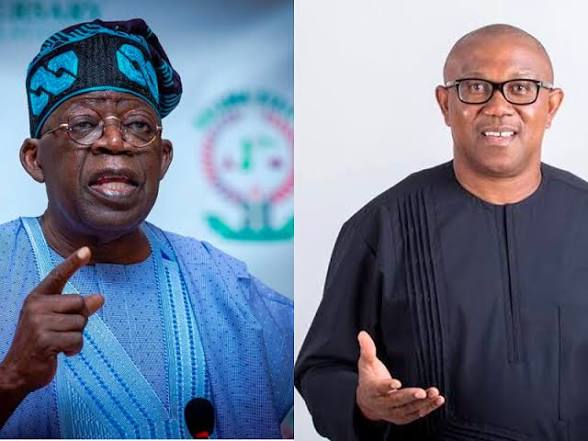
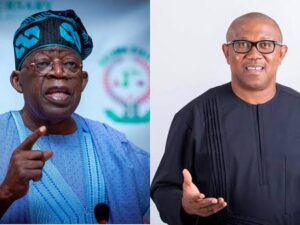
While supporters of President Bola Tinubu are urging former Anambra State governor and presidential candidate of the Nigeria Democratic Congress, NDC, Peter Obi to shelve his presidential ambition in 2027 and support Tinubu’s re-election.
However, an Igbo advocacy group has responded with a provocative counter-question: Why should Obi step aside for Tinubu when Tinubu can step aside for Obi?
The emerging confrontation has turned what began as an appeal for political accommodation into a broader debate over the place of the South-east in Nigeria’s evolving power equation.
The South-east chapter of the Renewed Hope for Greater Nigeria (RHGN), a group campaigning for Tinubu’s re-election, says it plans to engage influential Igbo leaders in an effort to persuade Obi to reconsider his 2027 ambition.
The group’s Deputy National Leader for the South-east, Mazi Franklin Ngoforo, disclosed the plan in Owerri after a meeting on strategies to secure victory for Tinubu across the five South-east states.
Ngoforo said the group would approach the leadership of Ohanaeze Ndigbo under Senator John Azuta Mbata, as well as respected elder statesmen, including former Commonwealth Secretary-General, Chief Emeka Anyaoku, and Commodore Ebitu Ukiwe, and urge them to lead a delegation to Obi.
But RHGN says its proposed intervention is not designed to diminish Obi or question his political stature.
Rather, Ngoforo presents it as a strategic appeal to the former governor to place what he describes as the long-term interests of Ndigbo above the immediate contest for the presidency.
His argument is built around political arithmetic.
If Tinubu wins a second term in 2027, he would be constitutionally barred from seeking another term after 2031. The South-east, Ngoforo argues, could therefore, use the 2027 election to forge a strategic political compact with the South-west, accumulate goodwill and build reciprocal political obligations that could strengthen its claim to the presidency when power next returns to the South.
In that calculation, supporting Tinubu now would not necessarily mean abandoning the Igbo presidential project. It would mean postponing it in pursuit of what RHGN considers a potentially more advantageous political arrangement.
“The issue is bigger than one election and bigger than one individual,” Ngoforo says, insisting that Ndigbo must begin to think beyond the immediate contest and ask what political alliances can deliver the presidency in the future.
But that argument has met a blunt rejection from the Igbo Heroes and Icons Foundation (IHIF), which has adopted Obi as its preferred candidate and is campaigning for a president of Igbo extraction in 2027.
Its National Coordinator, Chinedu Nsofor, says Obi has a constitutional right to contest and should not be pressured into surrendering that right.
Rather, he challenges RHGN to turn its persuasion campaign in the opposite direction: persuade Tinubu to step aside for Obi.
For IHIF, the issue is one of equity, fairness and political inclusion.
Nsofor argues that since the return to democratic rule in 1999, the presidency has largely moved between the North and South-west, with the South-south producing Goodluck Jonathan for five years. Olusegun Obasanjo, a Yoruba, spent eight years in office, while Umaru Yar’Adua and Muhammadu Buhari, both from the North, collectively occupied the presidency for 11 years.
The South-/east, he contends, has never enjoyed a sustained opportunity to produce Nigeria’s president since independence.
That history, in his view, makes 2027 different.
It is not simply another presidential election. It is, he argues, an opportunity to change a political pattern that has endured for decades.
“After Buhari’s tenure in May 2023, every right-thinking Nigerian expected that it was to be the turn of the Igbo to produce the successor to Buhari. But that was not to be,” Nsofor says.
He further questions whether the principle of federal character has been applied equitably to the South-east, pointing to what he describes as the region’s limited presence in some of the country’s most influential national offices.
Yet IHIF’s argument is not entirely anchored on ethnicity.
Nsofor insists that Nigerians should prioritise competence, qualification and capacity over tribe and religion when choosing their leaders.
That distinction is crucial because the emerging debate is gradually moving beyond the familiar argument over whose “turn” it is.
At its heart is a more difficult question: Should political power be secured through negotiation and strategic alliances, or through direct competition at the ballot box?
RHGN believes the South-east can gain more by negotiating with the South-west now and positioning itself for a future presidential bargain.
IHIF believes that such an arrangement risks turning the Igbo presidency into another promise perpetually deferred.
The difference between the two positions is, therefore, not the destination but the route.
One says: Support Tinubu today, build political capital and position the South-east for tomorrow.
The other says: Tomorrow has been postponed too many times; 2027 is the opportunity.
And Peter Obi is at the centre of that collision.
For his supporters, withdrawing from the race could amount to abandoning a political movement that has already demonstrated an ability to mobilise Nigerians across regional and demographic lines.
For RHGN, however, that same political influence makes Obi uniquely positioned to participate in a broader political bargain that could alter the South-east’s prospects in the years ahead.
The proposed intervention by Ohanaeze and elder statesmen, such as Anyaoku and Ukiwe, would therefore be more than a political courtesy call. It would amount to an attempt to persuade one of the South-east’s most prominent political figures to exchange an immediate presidential contest for a longer-term political calculation.
But IHIF’s response has introduced the question that could define the entire debate:
If political sacrifice is necessary for a future bargain, why must Obi be the one to sacrifice?
What guarantees exist that supporting Tinubu in 2027 would produce an Igbo presidency in 2031 or thereafter?
Who makes that commitment, and what happens if the political landscape changes?
Conversely, what happens if the South-east insists on contesting in 2027 and loses?
These are the difficult calculations now confronting those advocating either strategy.
For Ndigbo, therefore, the debate is rapidly becoming larger than Tinubu and Obi.
It is about whether the South-east should negotiate its way to power or fight for it; whether political patience is strategic wisdom or another name for indefinite postponement; and whether the region can convert its considerable political influence into a concrete pathway to the presidency.
The 2027 contest may ultimately produce only one winner, but the strategic decision facing the South-east is much bigger than the ballot.
It is a choice between waiting for power to be negotiated, and creating the political conditions to win it.
And perhaps the most uncomfortable question of all is the one now hanging over the South-east:
If the presidency is truly the destination, should Ndigbo wait for somebody to give them a turn, or organise, negotiate and compete until they take their place at the centre of national power?