
By James
Kindly share:
Former Kano State Governor and ex-presidential candidate, Rabiu Musa Kwankwaso, has officially defected to the African Democratic Congress (ADC), marking a significant development in Nigeria’s evolving political landscape ahead of the 2027 general elections.
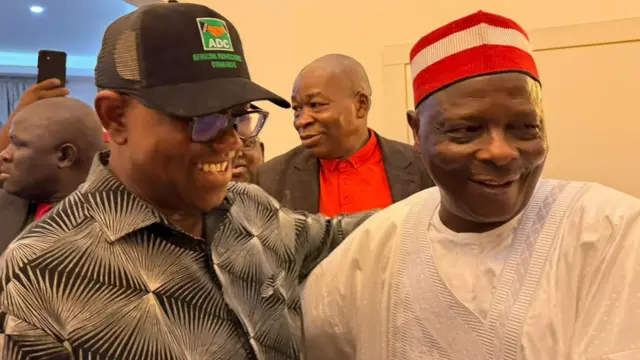
The high-profile move was formalised on Monday in Kano, where Kwankwaso received his ADC membership card in the presence of top party leaders who had gathered at his residence for the symbolic event. The ceremony signals the beginning of what many analysts see as a strategic political realignment capable of reshaping alliances across the country.
Kwankwaso’s exit from the New Nigeria Peoples Party (NNPP) did not come as a surprise to close watchers of Nigeria’s political dynamics. The former governor had, on Sunday, announced his resignation from the party in a personally signed statement, citing “recent changes in the country’s political direction” as a key reason for his decision.
He expressed gratitude for the opportunity to lead the NNPP and to fly its flag as presidential candidate during the 2023 elections, where he emerged as one of the prominent third-force contenders challenging the dominance of Nigeria’s two major political blocs.
Kwankwaso’s move to the ADC is widely interpreted as part of broader coalition-building efforts among opposition figures, seeking a stronger platform ahead of 2027. His political structure, widely known as the Kwankwasiyya Movement, commands a significant following, particularly in northern Nigeria, and could bolster the ADC’s national visibility and electoral strength.
Political observers believe the defection may trigger further shifts, as allies and loyalists within the Kwankwasiyya fold are expected to align with the ADC in the coming weeks.
With early permutations already shaping the 2027 race, Kwankwaso’s entry into the ADC introduces a new dimension to opposition politics. It raises questions about potential mergers, alliances, and the emergence of a formidable third force capable of challenging the ruling establishment.
As Nigeria inches closer to another election cycle, all eyes will be on how the ADC leverages Kwankwaso’s influence and whether this move will catalyse a broader realignment across the political spectrum.