



By Anthony
Kindly share:
There are moments in a democracy when silence speaks louder than debate, and procedure betrays purpose.
Nigeria’s Senate under the leadership of Godswill Akpabio is fast becoming one of such moments, an institution that looks busy, sounds authoritative, yet increasingly feels hollow.
The controversy surrounding the real time electronic transmission of election results has merely peeled back the curtain on a deeper problem: a Senate drifting from deliberative lawmaking into executive convenience.
At the heart of the matter is not just a clause in the Electoral Act, but a troubling leadership style that appears impatient with process and allergic to dissent. The Senate is meant to be a chamber of sober reflection, where laws are refined through committee work, transparent debate, and respect for institutional roles. Instead, what Nigerians witnessed was a rush toward “harmonisation” of a sensitive amendment, allegedly without recourse to the chairman of the committee that handled the bill. That single detail is not minor; it is foundational.
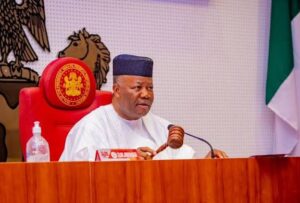
Senator Ali Ndume’s challenge to Senate President Akpabio was therefore not an act of rebellion but a rare moment of institutional sanity. By questioning how harmonisation could be “planned” without engaging the amendment committee, Ndume put his finger on the Senate’s growing dysfunction.
Committees are not decorative appendages; they are the engine rooms of legislation. To sidestep them is to reduce the Senate to a rubber stamp, where outcomes are predetermined and procedures are mere formalities.
Under Akpabio’s watch, the Senate increasingly projects the image of a lame duck legislature, one that flaps noisily but cannot soar. Debates are truncated, objections are waved aside, manipulated voice votes are used where clear voting is prescribed and controversial decisions are hurried through with the confidence of a chamber that knows it will not be held accountable.
The electronic transmission of results, a reform aimed at strengthening electoral credibility, deserved careful, transparent handling. Instead, it became another casualty of procedural shortcuts and leadership overreach.
The irony is stark. A Senate that should be asserting its independence appears more eager to please unseen interests than to protect democratic integrity. When leadership prioritises speed over scrutiny, loyalty over law, and control over consensus, the institution weakens itself. What emerges is not strength, but fragility disguised as authority.
Akpabio’s defenders may argue that firmness is necessary to run a complex chamber. But firmness is not the same as arbitrariness, and leadership is not synonymous with unilateralism. A strong Senate President builds consensus, respects committees, and allows dissent to sharpen decisions. A weak one suppresses questions, centralises power, and mistakes compliance for unity.
The electronic transmission controversy should worry every Nigerian, not because of where one stands on the policy, but because of what it reveals about the process. If laws can be “harmonised” without the knowledge or input of the very committee mandated to work on them, then the Senate has reduced itself to theatre, where scripts are written elsewhere and lawmakers merely perform.
This Akpabio Senate risks being remembered not for bold legislation or principled oversight, but for how casually it surrendered its soul. A legislature that cannot defend its own processes cannot defend democracy. And a Senate that silences its own members in the name of order ultimately legislates irrelevance.
Nigeria does not need a compliant Senate; it needs a courageous one. Until leadership understands this distinction, the Red Chamber will continue to look impressive from the outside, while limping badly within.
More troubling is the broader context in which this Senate conduct is unfolding. Nigeria is already a country under intense global scrutiny, on insecurity, human rights, electoral credibility, and democratic backsliding. In such a climate, any deliberate attempt to weaken electronic transmission of results ahead of 2027 is not a harmless political maneuver; it is democratic terrorism, an assault on the people’s right to choose their leaders freely.
To rig an election in today’s world is no longer a domestic affair. It invites consequences. The era when electoral malpractice could be hidden behind sovereignty slogans is over. Diplomatic pressure, visa bans, targeted sanctions, financial restrictions, and international isolation are no longer abstract threats; they are tools already in use. The recent signals from Western powers, including the United States, are warnings, not rhetoric. When a nation repeatedly undermines democratic norms, the response escalates.
Those who think Nigeria can afford another tainted election are playing with fire. The cost will not be borne by the political elite alone; it will spill into the economy, security architecture, and global standing of the country. Investors retreat. Allies recalibrate. Citizens suffer. A Senate that enables this trajectory is not just failing in oversight; it is actively complicit in national self-sabotage.
This is why the real time electronic transmission controversy matters. It is not about technology; it is about intent. It is about whether Nigeria’s lawmakers are preparing the ground for credibility or chaos. And history is unkind to institutions that choose short-term political convenience over democratic survival.
Anthony Iwuoma
Journalist/Columnist/ Pastor
Marriage &Family, Power