
By Publisher
Kindly share:
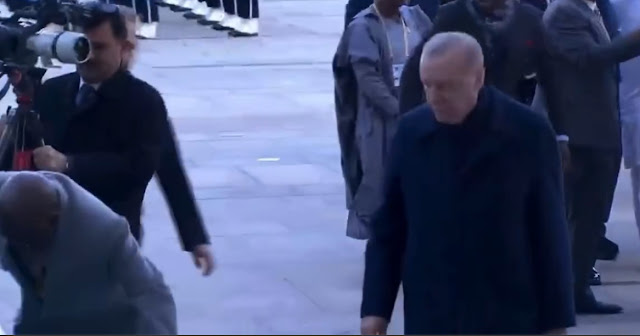
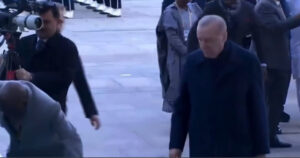
What was meant to be a routine moment of diplomatic pageantry briefly morphed into a viral distraction when President Bola Ahmed Tinubu momentarily lost his footing during an official welcome ceremony in Türkiye.
Captured on camera and amplified across social media, the incident showed the Nigerian leader stumbling on a blue carpet before aides swiftly helped him regain balance.
The Presidency swiftly doused speculation, clarifying that the slip was caused by a poorly laid carpet, not by ill health or fatigue.
President Tinubu was uninjured, composed, and immediately proceeded with his official schedule.
And that schedule mattered far more than the momentary optics.
President Tinubu’s visit to Türkiye is a high-stakes diplomatic mission designed to deepen Nigeria’s strategic engagement with one of Eurasia’s most influential middle powers. Beneath the ceremonial gloss lay substantive talks spanning trade expansion, defence cooperation, energy development, aviation, infrastructure, and investment, sectors central to Nigeria’s economic recalibration and security priorities.
Nigeria and Türkiye share decades of diplomatic relations, but the partnership has acquired renewed urgency in recent years. Türkiye’s expanding footprint in Africa, particularly in defence manufacturing, construction, industrial technology, and energy, aligns squarely with Nigeria’s push to diversify away from oil dependence, modernise its security architecture, and attract non-Western investment flows. Turkish companies already play visible roles in Nigeria’s construction and manufacturing sectors, while defence cooperation has quietly become a cornerstone of bilateral engagement.
Against this backdrop, the stumble, though visually dramatic, proved politically irrelevant. President Tinubu resumed bilateral talks almost immediately, engaging Turkish officials on strengthening economic ties, enhancing security collaboration, and expanding people-to-people exchanges.
For the Presidency, the message was unequivocal: this was a misstep of footing, not of leadership. The Nigerian leader remained firmly on course, advancing diplomacy aimed at repositioning Nigeria within a rapidly shifting global order.
That substance was reinforced during a joint press briefing with Turkish President Recep Tayyip Erdoğan, who reaffirmed Türkiye’s commitment to achieving a $5 billion trade volume with Nigeria, signaling a decisive push toward a new phase of economic cooperation.
Erdoğan disclosed that discussions toward this goal were already underway, with plans to activate a Joint Economy and Trade Committee to stimulate Turkish investment in Nigeria.
“Today, we conducted a comprehensive review of our relations with the esteemed president and his delegation in the fields of trade, investments, energy, education, and the defence industry,” Erdoğan said. “Our commitment is to the target of $5 billion trade volume, and we discussed the steps that need to be taken to achieve this.”
The Turkish leader also praised President Tinubu’s ongoing restructuring of Nigeria’s energy sector and expressed optimism that collaboration between the Turkish Petroleum Corporation and Nigerian partners would deliver concrete results.
On security, Erdoğan assured Nigeria of Türkiye’s readiness to support counterterrorism efforts, particularly against threats emanating from the Sahel region. “We stand by the friendly people of Nigeria in their fight against terrorism under the leadership of President Tinubu. We are ready to share our significant experience in the fight against terrorism,” he said.
President Tinubu, in response, thanked Türkiye for its partnership and its commitment to promoting global freedom, stability, and prosperity. He underscored the importance of inclusive economic growth that reaches vulnerable populations and commended Türkiye’s peace initiatives in Somalia, reaffirming Nigeria’s own commitment to peace and stability across Africa.
The visit concluded with the signing of nine bilateral agreements, covering diaspora policy, defence cooperation, trade facilitation, halal quality infrastructure, higher education, media collaboration, education, and social development.
In the final analysis, history is unlikely to remember the blue carpet. What will endure is whether the engagements in Ankara translate into tangible dividends at home, jobs, investment, enhanced security, and strategic leverage. On that score, the visit, stumble and all, remains firmly standing.