


By Amah
Kindly share:
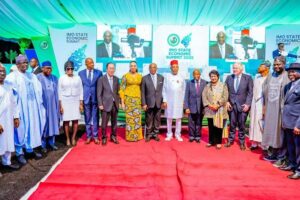
The recent Imo Economic Summit came and went like a Nollywood movie shot in three days, loud beginning, confused middle, and an ending that left everybody wondering whether the producers knew what they were doing.
In the grand hall where the summit was held, the air was thick with big grammar, oversize promises, and the fragrance of imported air fresheners. Outside the hall, however, the only air freshener available was the dust rising from the destruction of traders’ wares by government officials, who apparently forgot they were supposed to be improving the economy, not practicing demolition technology.
From the moment Governor Hope Uzodinma strolled into the venue with the confidence of a man whose economic policies had actually achieved something, it became clear that this summit would be remembered, not for solutions, but for the Olympic-level performance of verbal gymnastics.
The governor mounted the podium with his usual smile, the smile that says, “Relax, another miracle is about to be promised.” And promise he did. In fact, he served promises like a politician who knows promises are free, renewable, and recyclable. He reminded Imolites of the many wonderful things his administration had done, but which only he had seen. He spoke of projects that existed only on billboards, industries that existed only on PowerPoint slides, and roads that existed only until the first rainfall washed them back to their ancestral forms.
Somewhere in his speech, he revived the ghost of the Orlu–Okigwe Road Revolution, that magical road that appears and disappears, depending on whether a camera is present. He talked again about the Imo Industrial Park, that mythical land where investors were supposed to flock like pilgrims to a holy shrine, but which still remains at its original stage: an empty promise fenced by hope and held up by prayers. He also sprinkled in the usual references to the Imo Tech Hub, the one-time “Silicon Valley of the East” that has become more of a “Charging Valley of Owerri,” where youths gather not to build apps but to charge their phones while discussing which promises have aged the most gracefully.
Then he sang about job creation, oh yes, that timeless chorus. Imolites were reminded once again that 100,000 jobs had been “created,” although the jobs appear to be spiritual in nature since nobody has physically seen them. Even the ghosts were confused. They too applied and got no reply.
As the governor spoke, the summit participants nodded with the professionalism of people who had mastered the art of nodding at things they did not believe. Economic experts from within and outside the state nodded as if they were afraid their allowances depended on their neck muscles. Investors nodded like tourists who had mistakenly wandered into the wrong conference but didn’t want to appear lost. Everyone nodded, except the economy, which stubbornly refused to rise from its sickbed.
If you stood outside the hall long enough, you could actually hear the economy coughing.
Meanwhile, outside the gates, something far less glamorous was happening. Government officials were busy demonstrating their version of economic reform, by demolishing the property of small traders in the state capital. As the governor’s voice echoed inside, declaring the future bright, traders’ livelihoods were being swept away like contraband at a border patrol. Bags of garri were flying, vegetables were rolling on the ground like they were auditioning for an action film, and women were crying over destroyed goods while the summit was talking about attracting foreign investment. It was the kind of irony that makes you question whether someone in the government reads satire for inspiration.
Imagine the scene: inside, men in suits were talking about prosperity; outside, women were weeping over the prosperity that had just been bulldozed. Inside, the PowerPoint slides displayed graphs of exponential growth; outside, the only thing growing exponentially was the frustration. Inside, they were discussing how to increase commerce; outside, commerce was being violently evicted from its market stall without notice. If this was economic development, then poverty needed to issue a press release thanking the government for the free promotion.
At one point, a trader shouted, “Is this what they call an economic summit?” But she did not receive an answer, because the officials were too busy lifting baskets of tomatoes and pouring them into the gutter as if tomatoes were responsible for the state’s unemployment rate. Another trader attempted to retrieve her goods, only to be told that “the government is trying to sanitise the city.” Of course. Because the best way to sanitise a city is to sanitise the stomachs and pockets of its poorest residents.
Back inside the summit, the mood was cheerful. There were soft chairs, cold drinks, and speakers who delivered motivational speeches about innovation, resilience, global competitiveness, and every other term that sounds sweet until you try to apply it to a real shop in Owerri. One speaker even said Imo would soon become the economic powerhouse of the South-east. He said it with such confidence that for a moment, even the microphone believed him. But the audience didn’t. They clapped politely, the way Nigerians clap when they hear something unbelievable but don’t want to offend the speaker.
At some point, the governor announced that Imo State was on the verge of “another economic transformation.” People looked around nervously, praying that this transformation would at least involve keeping the roads intact for more than two months or preventing lorries from falling into potholes deep enough to qualify as minor lakes. But no such luck. The transformation appeared to be entirely theoretical, a place in the sky where everything works except reality.
What made the entire event even more hilarious was the confidence with which the government repeated old promises, the same promises that had been made, recycled, and refurbished across over four years. It was almost like watching a salesman confidently advertise a generator that everyone knew had refused to start since 2021. But he still promised that “this time, it will work,” as if hope was a mechanical tool.
Even more amusing were the summit communiqués. They sounded grand, visionary, futuristic, beautiful words that had absolutely no relationship with anything happening outside the hall. They spoke of economic inclusion, empowerment, infrastructural renewal, investment inflows, entrepreneurial renaissance, and all the other buzzwords that politicians use when they want people to clap instead of think. Yet, right outside those same gates, the only empowerment happening was the empowerment of bulldozers.
One can only imagine what foreign investors must have thought seeing chaos outside while hearing poetry inside. A few probably asked, “Is this part of the cultural display?” Others likely concluded that the best investment in Imo is to invest in prayers.
The funniest part of the entire saga is that after all the grammar, photos, applause, and declarations, the summit ended with absolutely nothing changing. The traders had already gone home with their losses; the roads were still auditioning for pothole-of-the-year awards; the tech hub still had more sockets than computers; and the job creation scheme was still hiding somewhere in the realm of spiritual employment. Yet the government proudly announced that “Imo is rising.”
Rising to where? Rising how? Rising with what? Perhaps, rising in the same way a balloon rises, beautiful for a moment until someone remembers to pinch it.
The truth is that the economic summit was less of a summit and more of a performance. A stage play where everyone acted their part: the government acted confident, the investors acted hopeful, the experts acted impressed, and the citizens acted patient. But outside, the real economy was acting confused.
In the end, the Imo Economic Summit achieved only one undeniable success: it proved that the government has perfected the art of organising summits without organising solutions. It also proved that economic development in Imo can be discussed in air-conditioned rooms but destroyed in the open air.
And, perhaps, that is the real tragedy, an administration so eager to impress the world that it forgets the people standing right outside the door. But not to worry. Another summit will come. More promises will be made. More grammar will be spoken. And if care is not taken, more traders will be displaced in the name of development.
Because in Imo, economic policy has become an art. The art of saying everything, doing nothing, and calling the result progress.